Simpsonville Mill, Pre-colonial mill complex in Simpsonville, Maryland, US.
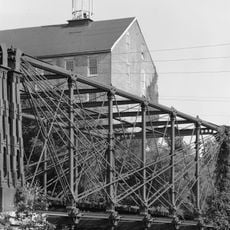
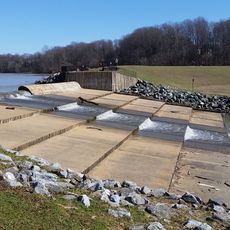
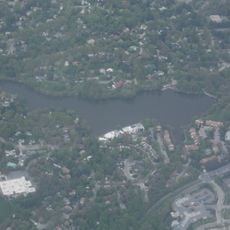
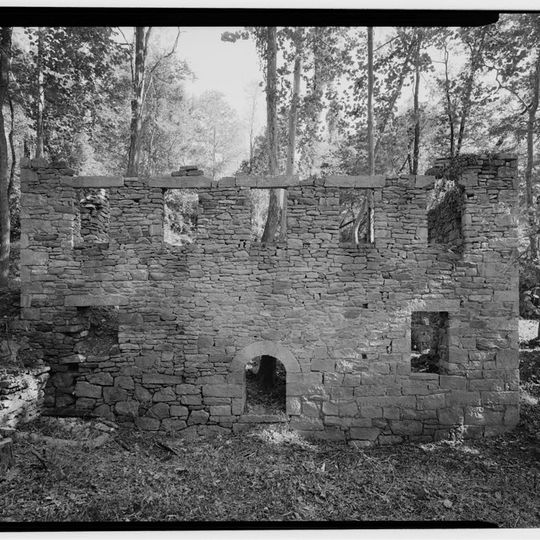
Simpsonville Mill is a ruined stone mill complex on the Middle Patuxent River in Simpsonville, Maryland. Its stone walls, mostly intact after a 1920 fire, stand beneath the Cedar Lane bridge next to the James and Anne Robinson Nature Center. The site includes water-control works such as a headrace, floodgate, overflow dam, wheelpit and tailrace.
John Hobbs Jr. bought land along the Middle Patuxent in 1741 and sold it to Joshua Dorsey in 1749; Dorsey listed the stone mill in his will in 1768. Richard Owings bought 11 acres around it in 1796 and expanded to 1000 acres. Charles Ridgley Simpson bought 215 acres in 1852 and switched production to wool cloth; a 1920 fire gutted the building, leaving the stone walls mostly intact.
The mill's names track its owners: Joshua Warfield's mill, Richard Owings' Mill, then Simpsonville Mill after Charles Ridgley Simpson bought 215 acres in 1852. Under Simpson, six employees ran six spindles, four looms and two carders making wool cloth. The Owings cemetery, a half dozen tombs on an overgrown part of a private Cedar Lane property, recalls the family that expanded the tract to 1,000 acres.
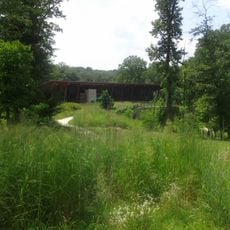
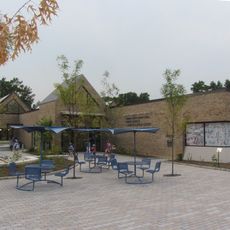
The site is easy to reach since it sits next to the James and Anne Robinson Nature Center and connects to local walking paths. Visitors should know that many remains are buried beneath the bridge, so what you see above ground shows only part of the original structures.
The 1993 realignment of Cedar Lane led to a $350,000 archaeological dig that found a dozen homes, a blacksmith and wheelwright shop, and evidence of a post office. The 1994 replacement bridge was built with stone arches meant to match the ruined mill beneath it.
The community of curious travelers
AroundUs brings together thousands of curated places, local tips, and hidden gems, enriched daily by 92,616 contributors worldwide.