Lehigh Gap, Water gap in Washington Township and East Penn Township, Pennsylvania, United States.
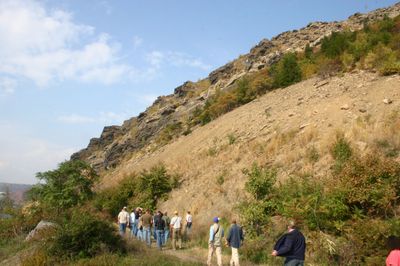
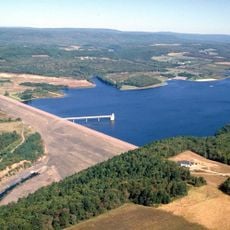
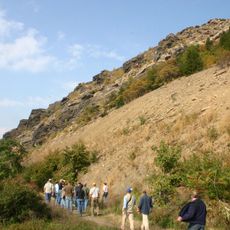
Lehigh Gap is a water gap in Pennsylvania where the Lehigh River cuts through Blue Mountain, forming a natural passage between Carbon County to the north and Lehigh County to the south. Steep rock walls rise on both sides of the river, and Pennsylvania Route 248 crosses through the opening at the base.
Four railroad companies once held trackage through the gap: the Lehigh and New England Railroad, whose bridge over the Lehigh River was abandoned in 1961 and torn down in 1967; the Lehigh Valley Railroad, with its Lehigh Line on the south side of the river; and the Lehigh and Susquehanna Railroad, leased to the Central Railroad of New Jersey and run as the Lehigh and Susquehanna Division on the north side. From 1898 to 1980 the New Jersey Zinc Company emitted sulfur dioxide at rates up to 3,600 pounds per hour, killing plant life; two decades later tree density on the Palmerton side is still visibly thin.
The village at the south end of the gap was once called Weider's Crossing. Appalachian Trail thru-hikers nickname the gap's exposed rock scramble "Dante's Inferno." The rock formation Devil's Pulpit resembles a church pulpit, and the Delaware and Lehigh Heritage Corridor Trail also crosses here.
Pennsylvania Route 248 runs directly through the gap and is the easiest way to reach the area by car. Hiking trails follow the river and climb the mountain slopes, but some sections are steep and uneven, so sturdy footwear is a good idea.
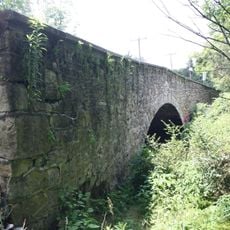
The Lehigh and New England Railroad bridge over the Lehigh River was abandoned in 1961 and torn down in 1967. Its foundations on both banks and old telegraph poles can still be seen. Appalachian Trail thru-hikers call the exposed rock scramble through the gap "Dante's Inferno".
The community of curious travelers
AroundUs brings together thousands of curated places, local tips, and hidden gems, enriched daily by 92,653 contributors worldwide.