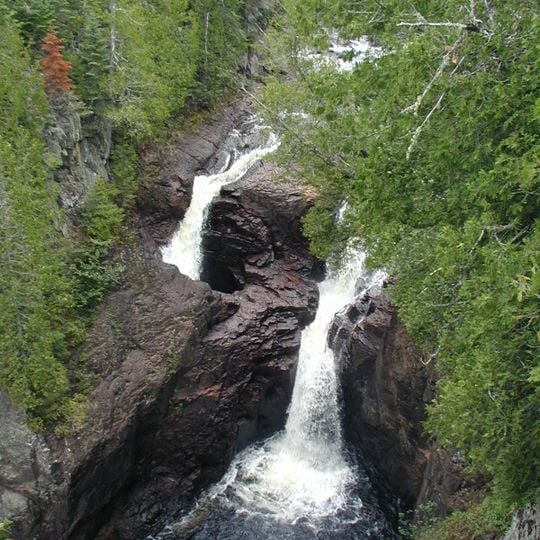
Devil's Kettle, Natural water formation in East Cook, Minnesota
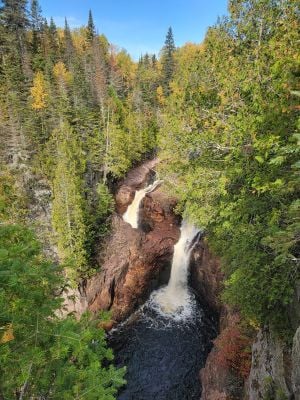
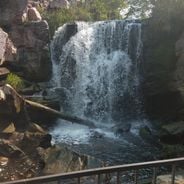
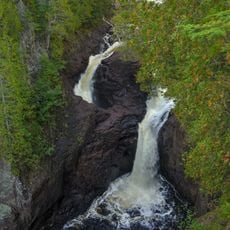
Devil's Kettle is a glacial kettle formation in Judge C. R. Magney State Park where the Brule River splits and one stream vanishes into a deep hole. The other current creates a standard waterfall at the same location, making this an unusual geological arrangement.
The Brule River splits over a rhyolite layer 2.4 km upstream of Lake Superior, sending one branch over a 15 m drop and the other into a pothole 3 m below its lip. Flow measurements showed the discharge above the falls nearly equals that below, so the western water rejoins the eastern current just downstream. Park officials refused a fluorescent dye test as scientifically unnecessary.
The name "Devil's Kettle" comes from the western branch, which drops about 3 m into a giant's kettle and seems to vanish under the rock. Visitors have thrown sticks, ping-pong balls and even a GPS tracker into the hole without recovering them. A flow measurement later showed the water rejoins the river just below the eastern cascade.
Access requires a walk through the state park with a climb involving multiple steps along the route, requiring moderate physical effort. The weather is more pleasant during warmer months, but the area remains walkable year-round.
Scientists spent years trying to solve the mystery by throwing colored dyes and other objects into the hole to track where the water reappeared. Recent hydrological research finally revealed that the water actually returns to the same river downstream rather than surfacing elsewhere.
The community of curious travelers
AroundUs brings together thousands of curated places, local tips, and hidden gems, enriched daily by 92,618 contributors worldwide.