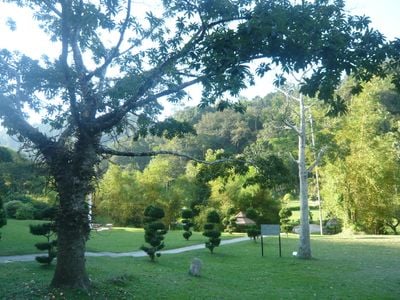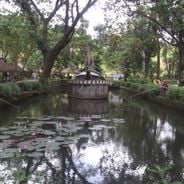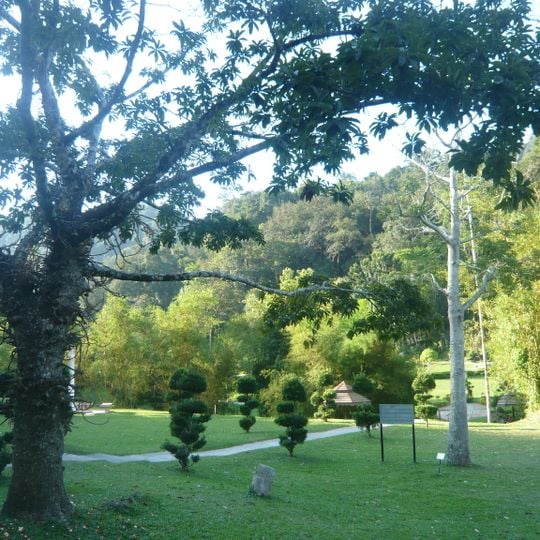
Penang Botanic Gardens, Botanical garden in George Town, Malaysia.
Penang Botanic Gardens is a 29-hectare space in George Town featuring diverse tropical plant collections organized into themed zones that showcase different species and landscapes. The site includes thousands of trees, flowering plants, and other vegetation distributed throughout marked sections.
The present gardens were laid out in 1884 by Charles Curtis, assistant superintendent under Nathaniel Cantley of the Singapore Botanic Gardens, on an old granite quarry site at Waterfall Road. Curtis turned it into one of three Experimental Gardens, the Waterfall Nursery Gardens, and shaped its layout after economic crop and forestry work passed to other departments. Two earlier gardens had preceded it: Christopher Smith's spice gardens of 1794 and William Edward Phillips's kitchen gardens of 1822, both in the Ayer Itam valley.
The gardens are also called Waterfall Gardens, after the cascading waterfall beside them on Jalan Air Terjun. The pinang palm that gave Penang its name grows here, along with a black lily bearing purplish-black flowers. Two orchid houses let visitors compare cultivated hybrids with wild orchid species.
The gardens sit in a valley at the end of Jalan Air Terjun, about 5 km west of central George Town. Trails lead from the gate up to Penang Hill and north to Mount Olivia, the former site of Stamford Raffles' home. The waterfall and reservoir are private property, visitable only by arrangement with the Penang Water Authority.
The gardens began as an old granite quarry site, which Charles Curtis transformed after his appointment in 1884; three Experimental Gardens were set up under him, including the Waterfall Nursery Gardens at 580 m that became the present Botanic Gardens. The site lies within the Penang Hill Biosphere Reserve, Malaysia's third reserve listed in UNESCO's World Network of Biosphere Reserves.
The community of curious travelers
AroundUs brings together thousands of curated places, local tips, and hidden gems, enriched daily by 92,630 contributors worldwide.