Copiapó Cathedral, Catholic cathedral in Copiapó, Chile
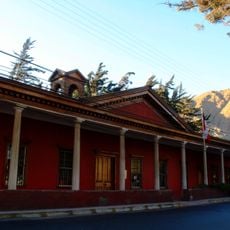
Copiapó Cathedral is a wooden church with double 13 mm partition walls that allow air to circulate between them. Its front has columns and is topped by a large square three-level tower ringed by columns. Inside, the tabernacle and altar pediment are of chased silver, and there is an Italian altarpiece by G. Fiorini.
A small parish built between 1748 and 1750 opened in 1766 and was destroyed by the Copiapó earthquake of 30 March 1796; for 55 years the Chapel of the Jesuits took over its functions. Construction of a new parish began in 1840, but in 1849 the French architect Juan Herbage advised against the adobe structure and it was demolished. English builder William Rogers and 16 carpenters then built the present church in Oregon pine and Maule oak, opened in 1851.
The cathedral is officially the church of Nuestra Señora del Rosario, and its silverwork includes a chiselled tabernacle and altar pediment, plus an Italian altarpiece by G. Fiorini. Tomb slabs of notable citizens are kept inside, and a side mausoleum holds the remains of Bishop Fernando Ariztía Ruiz.
The building sits centrally on the main square and is easy to find from surrounding streets. Keep in mind that it remains an active church used for daily worship and religious services.
An English builder named William Rogers led a team of craftsmen who constructed the building using innovative double-wall techniques. This construction method helped the structure withstand earthquakes in this seismically active region.
The community of curious travelers
AroundUs brings together thousands of curated places, local tips, and hidden gems, enriched daily by 92,644 contributors worldwide.