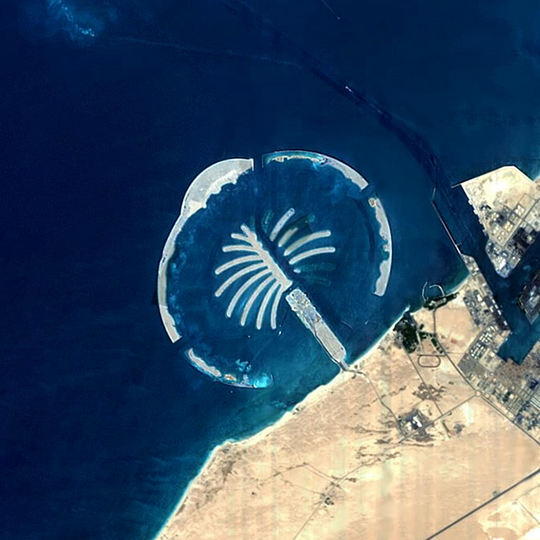
Palm Jumeirah, Artificial archipelago in Jumeirah, United Arab Emirates
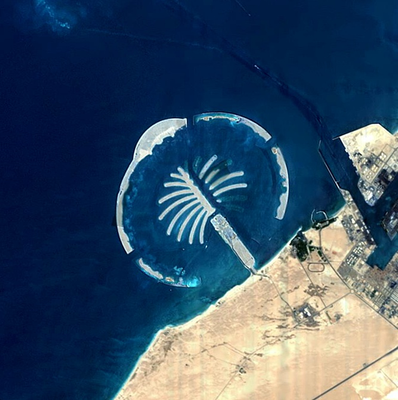
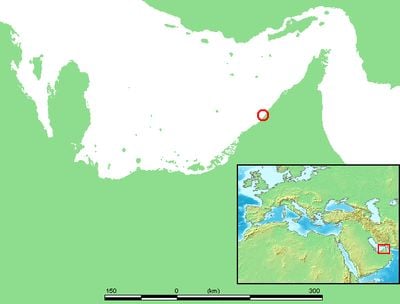
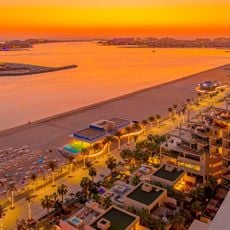
Palm Jumeirah is a palm-shaped artificial archipelago off Dubai's coast, with a central trunk and paired curved fronds enclosed by a crescent breakwater. Built from sand and rock, it has no concrete or steel and added 56 km (35 miles) of coastline.
Construction of Palm Jumeirah began in June 2001, financed mainly by Dubai's petroleum income, and was completed in 2009. The island was built entirely from sand and rock, with no concrete or steel, on the order of Sheikh Mohammed bin Rashid Al Maktoum, who conceived the palm design. Its opening ceremony was held in 2010, and by 2009, 28 hotels had opened there.
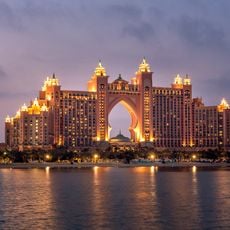
Nakheel built the archipelago to add 56 km (35 miles) of coastline and support Dubai's goal of tripling tourists to 15 million a year. The island is planned as a city within itself, with shopping centres, restaurants, hotels and residences. By 2009, 28 hotels had opened there.
Access to Palm Jumeirah is available via a subsea tunnel and a 5.4-kilometer (3.4-mile) monorail connecting multiple stations. Taxis and private vehicles serve the residential zones and hospitality properties throughout the development.
Engineers had to redesign the breakwater surrounding Palm Jumeirah after completion to address stagnant water conditions that threatened marine life, adding openings to improve circulation and oxygen levels in the enclosed lagoon.
The community of curious travelers
AroundUs brings together thousands of curated places, local tips, and hidden gems, enriched daily by 92,135 contributors worldwide.