Qemal Stafa Stadium, demolished football stadium in Tirana, Albania
Qemal Stafa Stadium was an oval football ground in Tirana with a grass pitch ringed by a dark running track. Curved concrete terraces held rows of pale yellow seats divided by stairways, and a lower concrete structure with a long horizontal window band stood below the stands. The stadium was demolished in June 2016.
Construction of the stadium began in 1939 but was delayed by World War II, with completion finally coming in 1946. The first match took place that same year during the Balkan Cup tournament, which Albania won, marking a proud moment for the nation.
The stadium carried the name of Qemal Stafa, an Albanian resistance fighter of World War II (1920–1942). It hosted six Albanian Spartakiads, national mass sports festivals held in 1959, 1969, 1974, 1979, 1984 and 1989. In January 2010 Partizani Tirana and the culture ministry asked for it to be renamed after the late player Panajot Pano, but the change was never made.
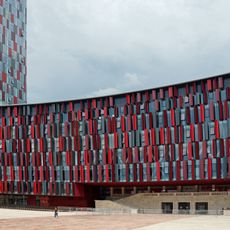
The stadium stood in central Tirana, and its site was cleared in June 2016 for the Arena Kombëtare, which opened in November 2019. The replacement is football-only: the athletics track was removed, and the exterior uses red and black, the colours of the Albanian flag.
In the 1970s, a large screen was added so spectators could watch scores and live images from the game in real time - an unusual technology for a stadium in Albania at that time. This detail shows how the country worked to modernize its sports facilities despite limited resources.
The community of curious travelers
AroundUs brings together thousands of curated places, local tips, and hidden gems, enriched daily by 92,756 contributors worldwide.