Makaravank, Medieval monastery in Achajur, Armenia
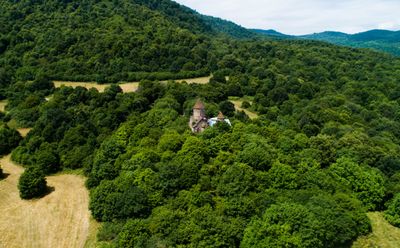
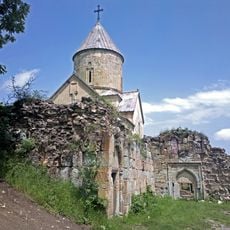
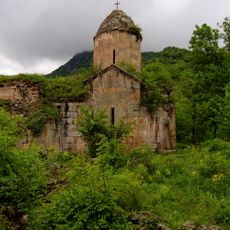
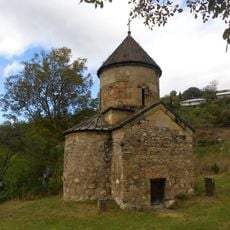
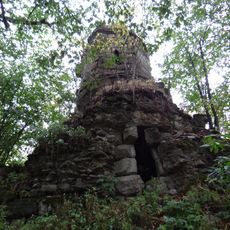
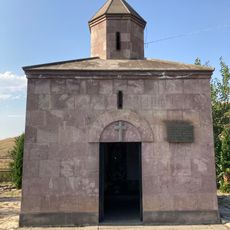
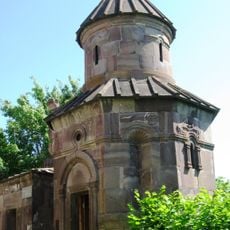
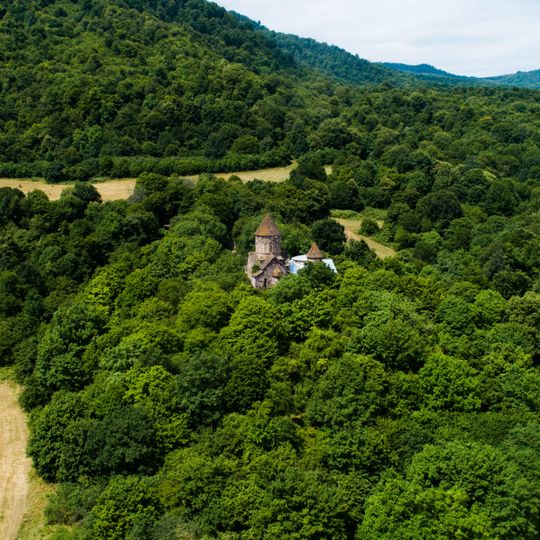
Makaravank is a monastery complex near Achajur that consists of several churches, a narthex, and secondary buildings constructed from pink andesite and red tufa stones. The structures sit on the slope of Mount Paitatap and form a unified religious center with distinct spatial areas.
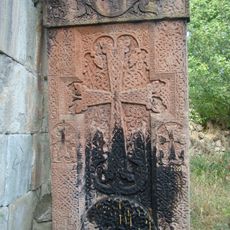
The complex was built between the 10th and 13th centuries. The oldest structure is a 10th-century cross-domed church with four chapels, distinguished by carved decoration on the altar apse and window frames. The Church of the Holy Mother of God was founded in 1198 by Abbot Hovhannes in memory of his parents and brothers, whose figures are carved before the entrance. The main church was erected in 1204–1205, and the gavit serving both churches dates to the 12th century. The 13th-century historian Kirakos Gandzaketsi records that Princess Arzu Khatun wove carpets for Makaravank, Haghpat and Dadivank.
The monastery's name comes from a legend: the master builder Makar and his son raised the walls, and after the son died Makar finished the church and threw himself from its top; he was buried beneath the wall. Kirakos Gandzaketsi records that Arzu Khatun, wife of the prince of Haterk, wove a curtain for Makaravank with her daughter. Look for the relief of a man holding tools inscribed "Youth", likely the name of the carving master.
The monastery sits approximately three kilometers southwest of Achajur village in Tavush Province, positioned on a mountain slope. Visitors should wear sturdy shoes and prepare for uneven terrain and potentially challenging weather conditions in the mountains.
The main church's south facade holds a sundial, and below it a dove sits on a corbel. The drum of the dome is ringed by a twelve-arch arcade on paired half-columns. At the monastery gate, water still runs through old clay pipes from a spring.
The community of curious travelers
AroundUs brings together thousands of curated places, local tips, and hidden gems, enriched daily by 93,132 contributors worldwide.