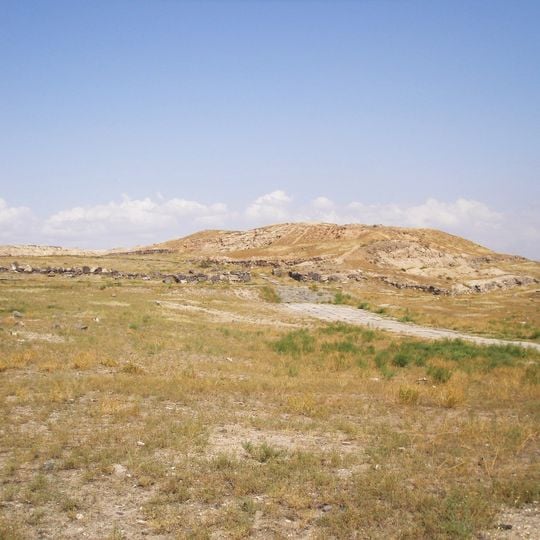
Teishebaini, Archaeological site near Yerevan, Armenia.
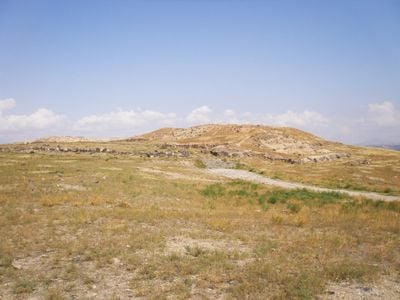
Teishebaini is a fortified Urartian city on Karmir Blur hill near Yerevan, Armenia. Its excavated remains include towered and buttressed perimeter walls, massive gates, a parade ground, and ground-floor storage rooms. The governor's palace had 120 rooms across more than 40,000 m², with stone walls, timber ceilings and timber columns. The site covers over 0.45 km² at 901 m elevation.
Rusa II, son of Argishti II, built Teishebaini in the mid-7th century BC, probably the last major city of Urartu, to guard the eastern borders against the Cimmerians and Scythians. Construction was completed only under Rusa III, some 50 years later. Around 585 BC the fortress fell to a sudden attack, most likely by the Scythians, and burned; the reddened bricks gave the hill its name, Karmir Blur.
The name Teishebaini comes from Teisheba, the Urartian god of war, and was first read on the iron locks of the fortress storerooms, restoring the city's Urartian name. Rusa II also built temples to the god Khaldi in the city. Excavations found a bronze statuette of Teisheba in the citadel in 1941.
The excavated area lies on Karmir Blur hill at 901 metres, with uneven ground and sparse grass. Sturdy shoes help on the slopes and around the exposed stone blocks and slabs. There is little shade, so morning or late afternoon visits are more comfortable.
The stones across the site turned reddish because of the fire that destroyed the city, and that color is still visible on the walls today. That same fire also preserved organic materials such as wooden beams and food stores, giving archaeologists a clear picture of daily life here.
The community of curious travelers
AroundUs brings together thousands of curated places, local tips, and hidden gems, enriched daily by 92,627 contributors worldwide.