Yeghvard Church, Medieval church in Yeghvard, Armenia
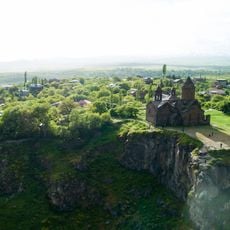
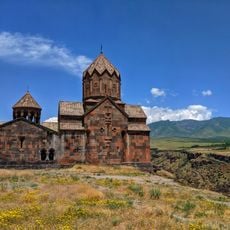
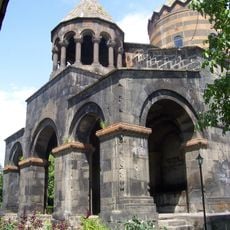
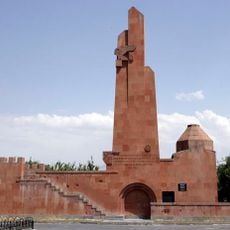
Yeghvard Church is an Armenian house of worship with a rectangular external form topped by a cylindrical drum supported by twelve columns and crowned with a cone-shaped dome. The structure stands in the town center and displays the architectural proportions and design typical of Armenian religious buildings from its era.
Completed in 1301, the church was built by Prince Azizbek on the basis of his wife Vakhakh's dream, to mark the millennium of Christianity as Armenia's state religion. It served as an alternative to the nearby ruined Katoghike basilica of the 5th-6th centuries and holds the remains of Azizbek's son, hence its name, the tomb church. It was restored in the 1960s, when the dome columns were replaced and reinforced.
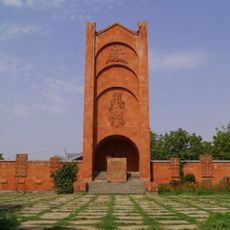
The church has had four names over its history: Holy Apostles, Holy Cross, Holy Sign, and finally Holy Mother of God. On the west façade a carved cross is flanked by the Virgin and Child and Joseph, with a bull and lion below; the north façade shows an eagle gripping a donkey, and beneath it the architect's name, Shahik Vardapet.
The church stands at the centre of Yeghvard, in Kotayk Province. The upper floor was reached by movable wooden stairs, not fixed stone steps, and remnants of exterior stone steps are still visible on the front façade. The building was restored in the 1960s, when the dome columns were replaced and reinforced.
In 2008 the church's cross was temporarily removed because damp was eroding it, and while it was off, a 7th-century church with blind foundations was found beneath the site, along with a tandoor, tombstones and broken khachkars of the 13th and 14th centuries. A 3-metre-deep pit north of the church had stored food and wine.
The community of curious travelers
AroundUs brings together thousands of curated places, local tips, and hidden gems, enriched daily by 93,005 contributors worldwide.