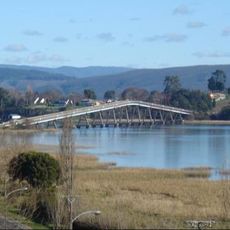
Pedro de Valdivia Bridge, Arch bridge in Valdivia, Chile.
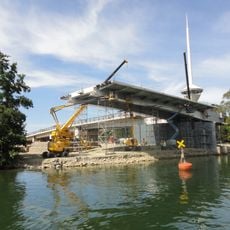
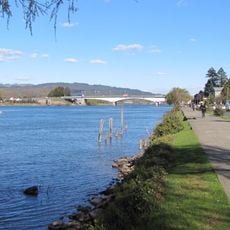
The Pedro de Valdivia Bridge is a concrete arch bridge that crosses the Valdivia River, linking the city center with Isla Teja on the opposite bank. Its arched design allows passage between both sides while accommodating local traffic and foot traffic.
The bridge opened in 1954 and became an important infrastructure milestone for the city. It proved its durability during the 1960 earthquake, one of the strongest ever recorded, when it remained structurally sound.
The bridge bears the name of the Spanish conquistador who founded the city during colonial times. This naming choice reflects the local connection to the region's Spanish colonial past.
The bridge carries a 7-metre roadway plus two 1.8-metre pedestrian walkways, so crossing on foot or by car is straightforward. It links the city centre with Teja Island, home of the Universidad Austral de Chile campus, and together with the Río Cruces Bridge gives access onward to the coastal town of Niebla.
After the 1960 earthquake, the region experienced the Riñihuazo flood, a destructive wave triggered by the quake itself. The structure survived not only the ground shaking but also the powerful water surge that followed.
The community of curious travelers
AroundUs brings together thousands of curated places, local tips, and hidden gems, enriched daily by 93,896 contributors worldwide.