Pablo Neruda Railway Museum, Railway museum in Temuco, Chile
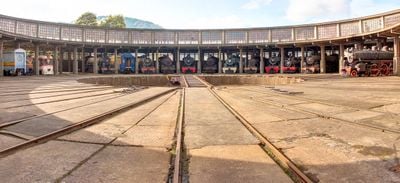
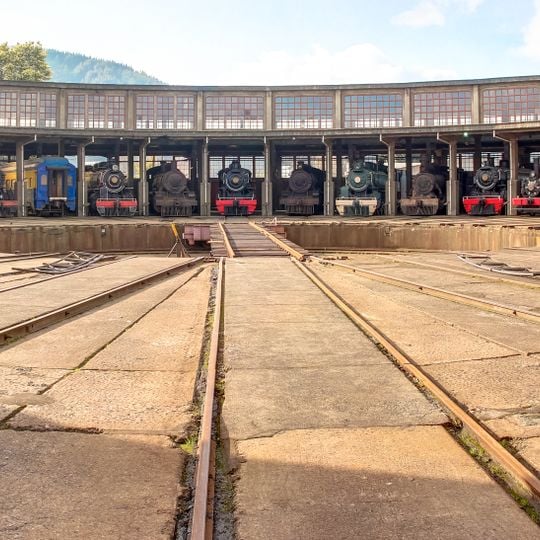
The Pablo Neruda Railway Museum is housed in the Casa de Máquinas de Temuco, a long single-storey shed with a corrugated roof and rows of glass-paned windows on Barros Arana street. Ten open bays face a metal turntable set in a concrete apron, with rails radiating outward. Inside stand fourteen locomotives built between 1908 and 1953, eight passenger cars and a steam crane.
The Casa de Máquinas was built in 1937 as a depot for locomotives and cars; the railway had reached Temuco in 1892, making the city a hub between the south and Santiago. It was declared a National Historic Monument on 1 December 1989 after efforts by the Chilean Association for the Conservation of Railway Heritage. In 2004 it joined the Pablo Neruda museum, and after 2010 earthquake damage it reopened on 3 May 2019.
The museum is named after Pablo Neruda, and since 2014 it forms part of the Ruta Patrimonial Huellas de Pablo Neruda. The site also includes the former administration building and drivers' school, now used as an art gallery. The coal elevator, or carbonera, stored about 3,000 tonnes of coal and fed up to three locomotives at once.
The museum is on Barros Arana street, between Valparaíso and Bascuñán, in Temuco. The Casa de Máquinas was restored after the 2010 earthquake and reopened on 3 May 2019, following an investment of 6,265 million pesos. The locomotives stand in open bays around a turntable on a concrete apron, so the collection can be viewed on foot at ground level.
The museum's coal elevator, or carbonera, stored about 3,000 tonnes of coal and began operating in 1935 with three workers. Coal arrived by train from the Lota, Schwager and Curanilahue mines, was lifted nearly 40 metres and dropped into the tenders of up to three locomotives waiting below. It was declared a national monument in 2000.
The community of curious travelers
AroundUs brings together thousands of curated places, local tips, and hidden gems, enriched daily by 92,634 contributors worldwide.