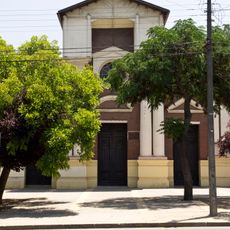
Iglesia de San Antonio de Padua, Neobarroco church in Barrio Brasil, Santiago, Chile
The Iglesia de San Antonio de Padua is a Neobarroco church distinguished by three naves separated by Corinthian columns and built on stone foundations with brick walls. The roof is constructed from oak and cypress wood, creating a sturdy vault over the interior space.
Construction of this church took place between 1853 and 1861 under architect Eusebio Chelli working for the Capuchin order. This building arose during a period when Santiago was expanding its religious infrastructure for various monastic communities.
The church is also known as the Iglesia de los Capuchinos, after the Capuchin friars who arrived in Chile in 1848 and settled on land donated by Vicente Larraín Espinosa and Valentín Fernández Beltrán. The murals on the ceiling by Juan Mochi depict themes related to the Capuchin order, and the side aisles hold devotional altars and confessionals.
The church stands at Catedral street no. 2345, in Barrio Yungay rather than Barrio Brasil. The main entrance on Catedral street ends in a triangular pediment framed by pilasters; the side aisles hold the devotional altars and confessionals. Look up at the ceiling for Juan Mochi's murals.
The main altar holds a sculpture replicating a work by 17th century Spanish painter Bartolomé Esteban Murillo. This reproduction captures a deeply personal religious moment in sculptural form.
The community of curious travelers
AroundUs brings together thousands of curated places, local tips, and hidden gems, enriched daily by 92,783 contributors worldwide.