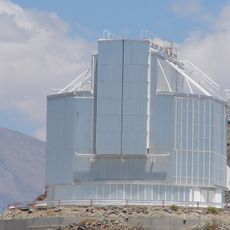
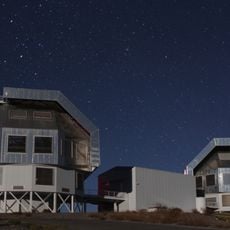
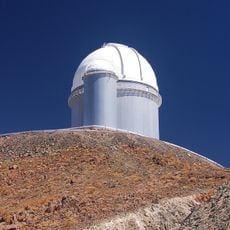
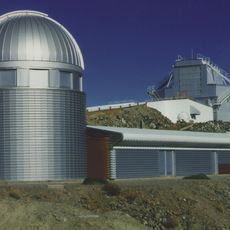
MASCARA, Exoplanet survey telescope network in La Silla, Chile, and La Palma, Spain
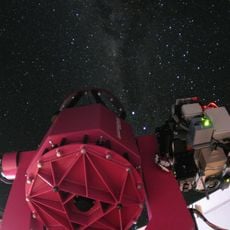
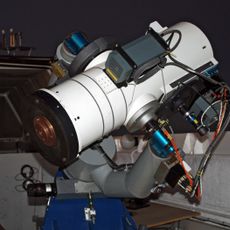
MASCARA is a network of automated optical telescopes at two observatory sites designed to detect exoplanets by measuring brightness dips as planets pass in front of their host stars. The system uses multiple cameras at each location to scan the sky continuously and monitor thousands of stars at the same time.
MASCARA was developed by Leiden University as a two-station exoplanet survey, with one station per hemisphere. The northern station at Roque de los Muchachos Observatory on La Palma began observations in February 2015; the southern station at La Silla Observatory in Chile saw first light in July 2017. The survey reported its first confirmed planet, MASCARA-1b, on 17 July 2017, followed by MASCARA-2b the same year, MASCARA-4b in 2019 and MASCARA-5b in 2021.
MASCARA's name stands for Multi-site All-Sky CAmeRA, and its two stations are named for their hemispheres: the northern one at Roque de los Muchachos Observatory on La Palma and the southern one at La Silla Observatory in Chile. The survey reported its first confirmed planet, MASCARA-1b, on 17 July 2017, a hot Jupiter transiting an A-type star.
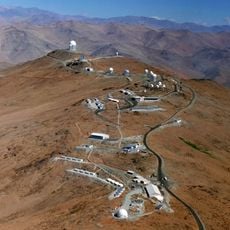
MASCARA has no visitor access: both stations are automated and run unattended, the northern one at Roque de los Muchachos Observatory on La Palma and the southern one at La Silla Observatory in Chile. The Chilean site lies at the southern edge of the Atacama Desert, so anyone near La Silla should plan for cold, dry, dark nights.
MASCARA's first confirmed planet, MASCARA-1b, was reported on 17 July 2017, the same month the southern station at La Silla saw first light. It is a hot Jupiter with a mass of 3.7 Jupiter masses, an orbit misaligned with its A-type star's rotation, and a measured geometric albedo of 0.171.
The community of curious travelers
AroundUs brings together thousands of curated places, local tips, and hidden gems, enriched daily by 94,579 contributors worldwide.