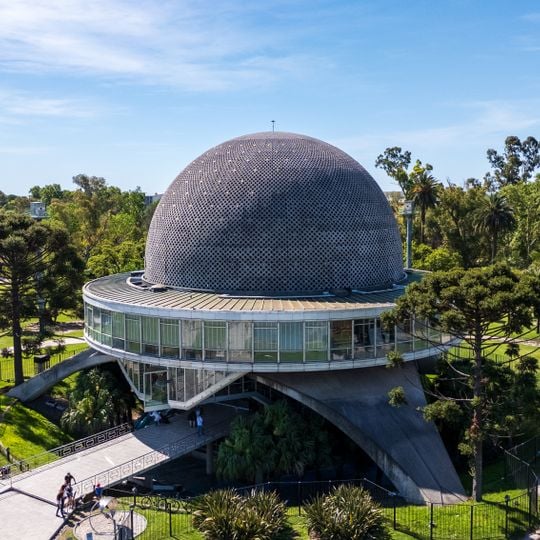
Planetario Galileo Galilei, Planetarium in Parque Tres de Febrero, Argentina.
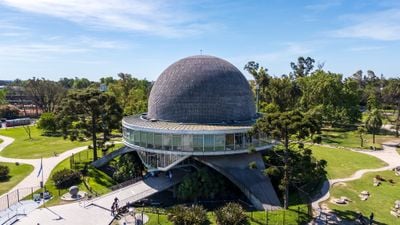
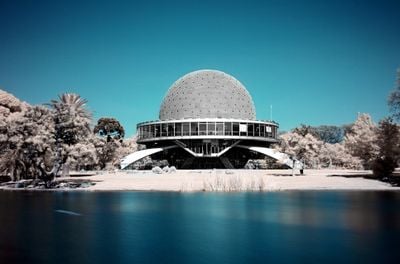
Planetario Galileo Galilei is a planetarium in Parque Tres de Febrero, Buenos Aires, Argentina. Its 20-metre semispherical dome is clad in 960 prefabricated panels over a white ring of rectangular glass windows, and the drum rests on angled concrete struts; below, two large curved white concrete forms extend outward to the left and right. A spiral ramp with a railing leads up to the entrance level.
The facility opened on December 20, 1966, to bring astronomy closer to the people of Buenos Aires and encourage scientific interest across the city. Construction took place during a period when several Latin American countries were investing in educational infrastructure for the natural sciences.
The name honors the Italian scientist who used the telescope to observe the heavens and laid the foundation for modern astronomy. Families often visit on weekends to watch the star shows together and learn about the cosmos in a shared experience.
The location sits near several bus lines and the Palermo subway station, making it easy to reach by public transport. Presentations run multiple times each day, and checking the schedule online before visiting is recommended.
The dome's projection system reproduces 8,900 fixed stars, constellations and nebulae. On the entrance terrace stand three metallic meteorites found in Argentina, among them "La Perdida", picked up in 1965 in the Campo del Cielo area of Chaco Province. The first-floor museum holds a lunar rock brought back by Apollo 11 and given by Richard Nixon.
The community of curious travelers
AroundUs brings together thousands of curated places, local tips, and hidden gems, enriched daily by 92,742 contributors worldwide.