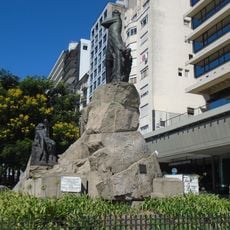
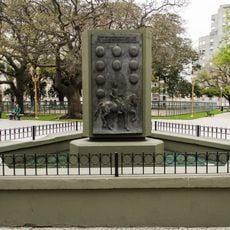
Equestrian statue of José de San Martín, Bronze equestrian monument at Plaza San Martín, Buenos Aires, Argentina.
The equestrian statue of José de San Martín is a bronze monument on Plaza San Martín in Buenos Aires, set on a polished red granite base. San Martín, shown clean-shaven with short sideburns, points the way forward for his troops, as in a lithograph by Théodore Géricault. The horse has only two points of support, unlike the Chilean original whose tail was fixed to the plinth.
French sculptor Louis Joseph Daumas created this first equestrian statue in Buenos Aires in 1862 as a tribute to Argentine independence from Spain. The work appeared decades after the liberation wars and became a model for many later monuments across the country.
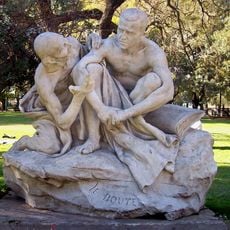
The red granite base carries four corner sculptures depicting the departure to war, the battle, the victory, and the return, recalling the main stages of the independence movement. These figures show moments that were decisive for the birth of the Argentine nation and can be observed closely by walking around the monument.
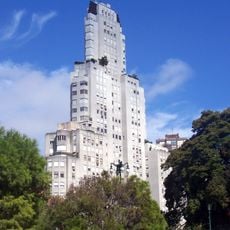
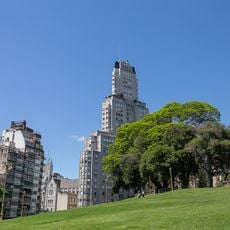
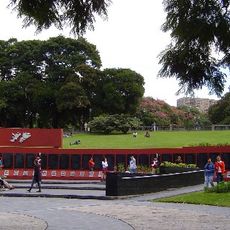
The monument stands in the middle of Plaza San Martín, a park with old trees and wide paths, near Retiro station. The spot is easy to reach on foot and offers a good view of the statue from several sides.
The statue rests on only two points of support, since its horse's tail is not attached to the plinth, unlike the Chilean original where earthquakes required it. Argentina later gave an exact copy of the equestrian group, without the allegorical figures, to the United States; it was unveiled in Washington on 28 October 1925 with President Calvin Coolidge present. Copies also stand in Cádiz and Madrid.
The community of curious travelers
AroundUs brings together thousands of curated places, local tips, and hidden gems, enriched daily by 92,642 contributors worldwide.