Planetario de La Plata, Scientific educational center in La Plata, Argentina.
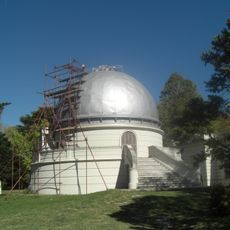
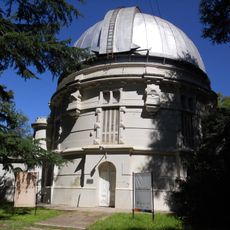
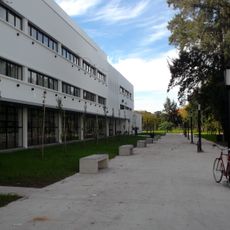
The Planetario UNLP stands in the Paseo del Bosque, next to the Observatorio Astronómico, and is run by the Faculty of Astronomical and Geophysical Sciences of the National University of La Plata. The building covers about 1,200 m², and its projection dome measures 17 metres across; shows are projected digitally in 4K. The central hall holds the interactive science museum "Ciencia al Toque".
The idea dates to a 2003 competition by the UNLP's astronomy and architecture faculties to add a planetarium to the Observatorio complex in Paseo del Bosque. In 2005 university president Gustavo Azpiazu revived the winning proposals, and architects Gustavo San Juan, Gabriel Santinelli, Pablo Murace and Cristian Willemoës drew up the final design. Construction ran from 2010 to June 2013, funded with 16 million pesos from the provincial government, the national university policies secretariat and the UNLP.
The planetarium's name is tied to UNLP, whose astronomy and geophysics faculty runs it, and entry to all activities is free. In the central hall, the interactive science museum "Ciencia al Toque" lets visitors handle didactic modules. On Fridays at 19:00, specialists give talks in the "Viernes en el Observatorio" cycle, open until the hall is full.
The center is open on weekends and holidays with shows at different times during the day. Visitors should know that the entrance is easy to find and the facility has accommodations for people with limited mobility.
The projection hall has a magnetic loop for the hard of hearing and access ramps for visitors with reduced mobility. In the central hall, the interactive science museum "Ciencia al Toque" gathers hands-on modules. The building cost 16 million pesos, funded by the provincial government (8 million), the national government (5 million) and the UNLP (3 million).
The community of curious travelers
AroundUs brings together thousands of curated places, local tips, and hidden gems, enriched daily by 93,625 contributors worldwide.