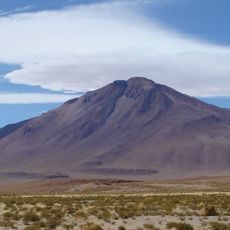
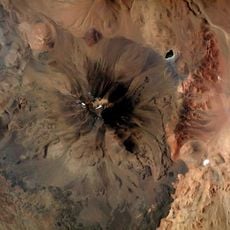
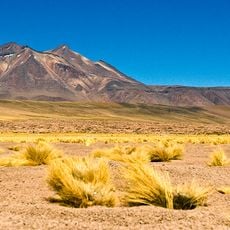
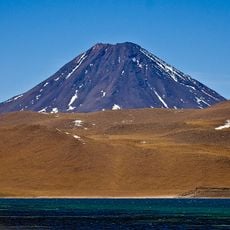
Volcán Quehuar, Dormant stratovolcano in Salta Province, Argentina.
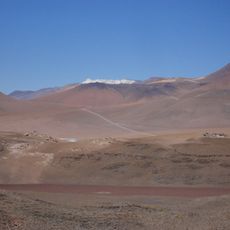
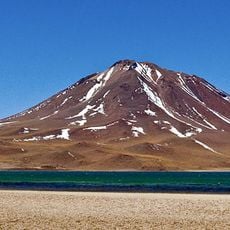
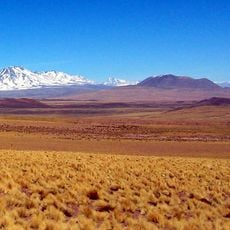
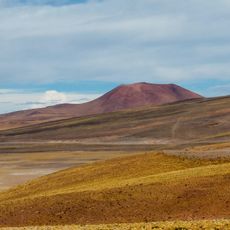
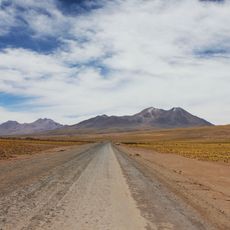
Volcán Quehuar is an inactive snow-capped volcano in the Andes of Salta Province, Argentina, rising to 6,130 m. Seasonal snow covers it most of the year, and a small glacier lies inside its crater. It stands on the Argentine altiplano, whose surrounding terrain lies between 3,800 and 4,000 m.
Inca builders left two ceremonial structures near the summit, one possibly the only ushnu, a stepped platform, known from such a high-altitude ceremonial site. In 1999 an expedition led by Johan Reinhard, José Antonio Chávez and María Constanza Ceruti recovered the remains of an Inca girl sacrificed in a capac cocha ceremony, later damaged by treasure hunters' dynamite.
The volcano takes its name from the Quehuare people, who lived south of Cusco and held the status of Incas by privilege. This ancient connection to a specific ethnic group shapes how locals understand and refer to the mountain today.
The summit lies in Salta Province, reachable from the city of Salta, about 200 km away, by bus or hired car over roughly four hours. Start early to avoid afternoon winds. The climb demands fitness and high-altitude clothing and equipment, and a local guide familiar with the area is advised.
Near the summit stand two unusual Inca ceremonial structures; one may be the only ushnu, a stepped platform, known from such a high-altitude ceremonial site. In 1999 Johan Reinhard, José Antonio Chávez and María Constanza Ceruti recovered the remains of an Inca girl sacrificed in a capac cocha ceremony, after treasure hunters had dynamited the burial.
The community of curious travelers
AroundUs brings together thousands of curated places, local tips, and hidden gems, enriched daily by 93,609 contributors worldwide.