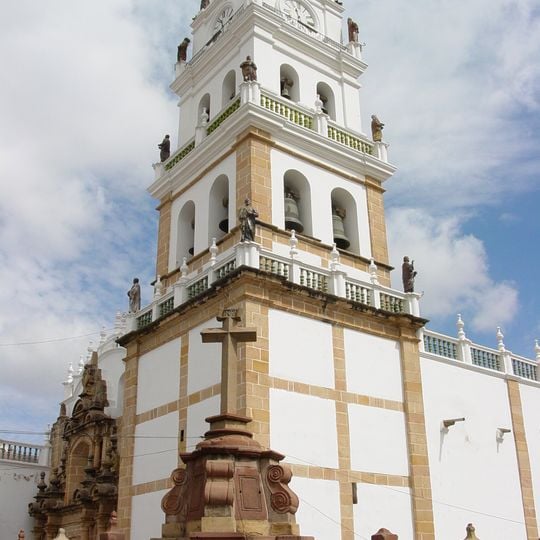
Sucre Cathedral, Renaissance cathedral in Sucre, Bolivia.
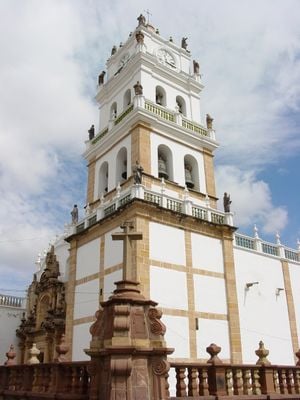
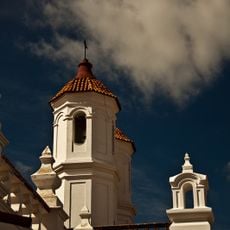
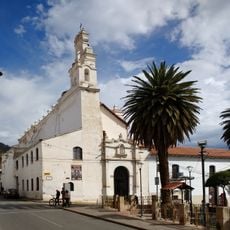
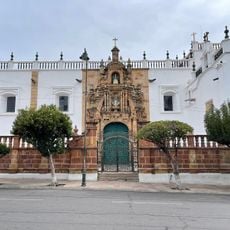
Sucre Cathedral is a stone building on Plaza 25 de Mayo whose square tower rises in cream and tan stone: white plaster panels framed by exposed stone blocks below, white upper sections with three arched belfries holding dark bells, and balustrades with statues of figures on pedestals between the levels. A clock face sits near the top, and a stone cross on a carved stepped pedestal stands before the base. Its tower carries images of the twelve apostles and four evangelists worked in terracotta.
Construction began in 1551 as the Cathedral Church of Charcas and continued for over 150 years with various modifications and expansions. The building stages reflect the shift from Renaissance to baroque style and show how the city developed during this long period.
The chapel of the Virgin of Guadalupe, built in 1617 beside the cathedral, holds a painting of Sucre's patroness made by Fray Diego de Ocaña in 1601. Residents call her the Mamita de Guadalupe and have covered the image with jewellery, including a repoussé silver sheet set with precious stones and pearls.
The cathedral sits on Plaza 25 de Mayo in the city center and is easily reached on foot. Visitors should know that services take place on certain days, which can affect access to parts of the building, so it helps to check ahead.
The tower's upper levels carry terracotta figures of the twelve apostles and four evangelists, modelled in clay rather than carved in stone. The cathedral museum holds one of Bolivia's main collections of sacred art from the 16th to the 19th centuries. In the adjoining chapel of the Virgin of Guadalupe (1617) hangs a 1601 painting by Fray Diego de Ocaña, the city's patron, known as the Mamita de Guadalupe and covered over time with jewels, pearls and a repoussé silver sheet.
The community of curious travelers
AroundUs brings together thousands of curated places, local tips, and hidden gems, enriched daily by 93,011 contributors worldwide.