Fuente Talavera de la Reina, Spanish ceramic fountain at Praça Montevidéu, Porto Alegre, Brazil
The Fuente Talavera de la Reina is a fountain clad in Spanish ceramic tiles in cobalt blue, ocher yellow and white, standing on Praça Montevidéu. It has a large lower double basin in a dodecagon and a round double basin at the center on a pedestal with four dolphins. A panel bears the inscription: "LA COLONIA ESPAÑOLA AL GLORIOSO PUEBLO RIOGRANDENSE EN SU CENTENARIO FARROUPILHA 1835 1935".
The fountain was conceived by sculptor Fernando Corona and executed by Talavera ceramist Juan Ruiz de Luna as a gift from Porto Alegre's Spanish community, inaugurated in 1935 for the Farroupilha Revolution centenary. Ambassador Vicente Salles secured free shipping, President Getúlio Vargas granted import tax exemption, governor Flores da Cunha eased inland transport, and mayor Alberto Bins provided the site.
The fountain was a gift from Porto Alegre's Spanish community, and its plaque reads "La colonia española al glorioso pueblo riograndense en su centenario farroupilha 1835 1935". The cobalt-blue, ocher-yellow and white tiles were made by the Talavera ceramist Juan Ruiz de Luna to a design by the sculptor Fernando Corona.
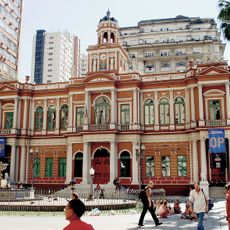
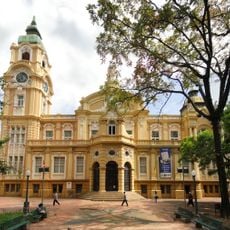
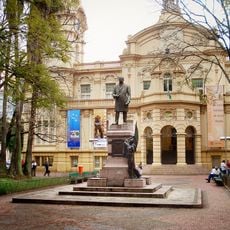
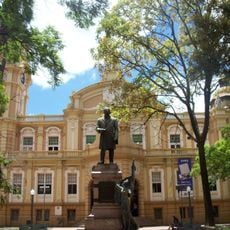
The monument sits at Praça Montevidéu and marks kilometer zero of the city. It stands directly in front of the Municipal Palace, making it easy to spot and visit on foot.
The upper basin damaged in the 2005 protest was replaced in 2008 with pieces from Spain, but the new basin's colors and shape differ from the original. The broken original is displayed in the basement of the Paço Municipal.
The community of curious travelers
AroundUs brings together thousands of curated places, local tips, and hidden gems, enriched daily by 92,782 contributors worldwide.