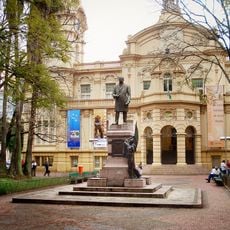
Monumento a Júlio de Castilhos, Bronze and granite monument in Praça Marechal Deodoro, Porto Alegre, Brazil
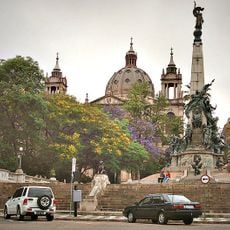
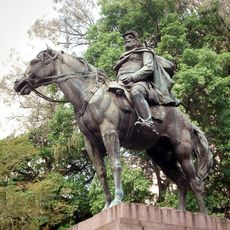
The Monumento a Júlio de Castilhos rises 22.5 metres around a pyramidal core topped by a triumphant Republic holding the flame of the new social order and the codex of the new law, standing on a sphere with stars for the Brazilian states. On the west face a young man leans forward offering copies of the newspaper A Federação; on the north face Castilhos sits enthroned in meditation, flanked by Courage, Prudence, Firmness and Civism; the east face shows him as a long-bearded sage, and the south face a young gaucho on horseback.
Júlio de Castilhos died on 24 October 1903, and construction of his monument was decided soon after, with a design by painter and sculptor Décio Villares. Work finally began on 27 July 1910 under Affonso Hebert, with stonework by Jacob Aloys Friedrichs; the scaffolding once collapsed and the work had to restart. The monument was inaugurated on 25 January 1913, when the state government handed out a pamphlet explaining its symbolism.
The figures surrounding the monument tell stories about values that matter to Rio Grande do Sul. You see gaucho riders and female figures that together reflect how people here understand their region and its past.
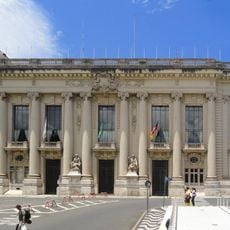
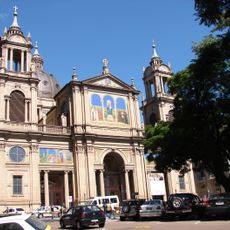
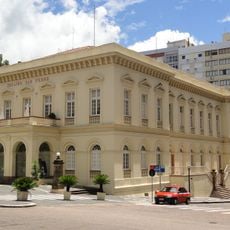
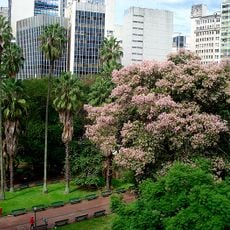
The monument is located on a central plaza in downtown Porto Alegre, within walking distance of government buildings and easy to reach by foot. The public square is open during the day and offers good sightlines to view the sculpture from different angles.
The base of the monument features a geometric pattern of stars, with each star representing one of the Brazilian states and creating a connection to national unity. This detail is often overlooked by visitors but carries important symbolic meaning for understanding the structure.
The community of curious travelers
AroundUs brings together thousands of curated places, local tips, and hidden gems, enriched daily by 92,790 contributors worldwide.