Pico do Jaraguá, Mountain summit in São Paulo, Brazil.
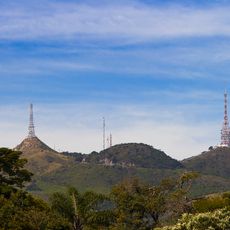
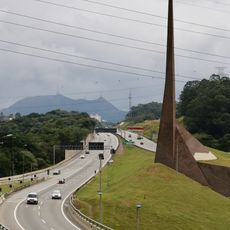
Pico do Jaraguá is the highest point of São Paulo municipality, a wooded summit of the Serra da Cantareira rising to 1,135 metres. Two rounded peaks carry the transmission towers: a red-and-white banded lattice mast on one, a plain grey mast with antennas clustered at its base on the other. A 130-metre mast stands on the highest peak, built through a Globo-Bandeirantes partnership, while TV Cultura's mast occupies the nearby lower peak.
Portuguese explorer Afonso Sardinha discovered gold deposits here in 1580, which sparked mining operations in the area. These mines continued to be worked through the nineteenth century, shaping the mountain's early story.
The name Jaraguá comes from Tupi and is usually translated as "Lord of the Valley". The Guarani who have lived since the early 1960s in the Jaraguá-Itu tekoá (village) inside the state park regard the peak as a sacred mountain and call it Itaju marã e'y, roughly "primordial golden stone".
The summit can be reached by the paved Estrada Turística do Jaraguá or on foot via the 1,800-metre Trilha do Pai Zé. At the top, a large staircase beside the television tower climbs higher, flanked by a cable car used to carry people and materials for antenna maintenance. Parking areas and small commercial facilities sit near the antennas.
A 130-meter television transmission mast has stood at the peak since the 1960s, merging natural landscape with broadcasting infrastructure. This structure is visible from far away and has become part of the city's skyline over the decades.
The community of curious travelers
AroundUs brings together thousands of curated places, local tips, and hidden gems, enriched daily by 93,357 contributors worldwide.