Niterói Contemporary Art Museum

Log in to your account

AroundUs is a community-driven map of interesting places, built by curious explorers like you. It grows with every review, story, and photo you share.
Connect to save your favorite spots, contribute locations, and create personalized routes.
By continuing, you accept our Terms and Conditions and our Privacy Policy
Add to collection
Map
Suggest a change
Share

Niterói Contemporary Art Museum, Contemporary art museum in Niterói, Brazil

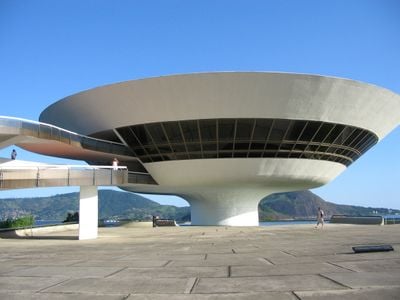
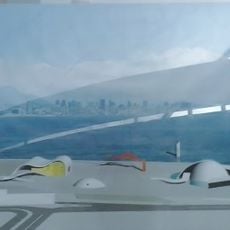
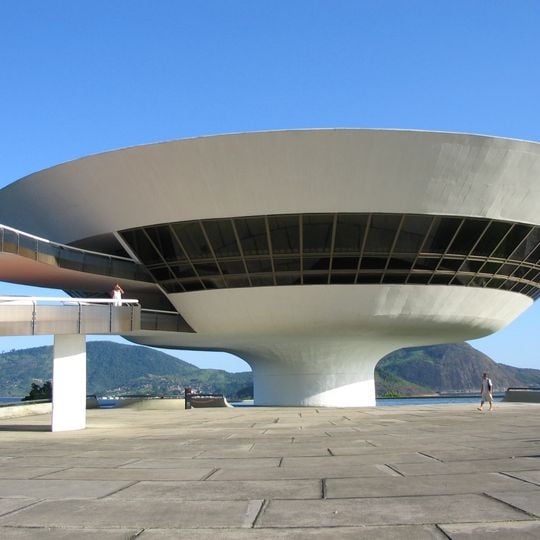
The circular building rises 16 meters above a cliff overlooking Guanabara Bay, featuring a cupola 50 meters in diameter. The concrete and glass structure rests on a cylindrical base and is surrounded by a reflecting pool that enhances the futuristic architecture.

Oscar Niemeyer designed this structure with engineer Bruno Contarini, completing it in 1996 as a new cultural center for Niterói. The project emerged from collector João Sattamini's initiative to donate his extensive art collection to the city, prompting the creation of a dedicated space for contemporary art.

This institution holds 1,217 contemporary artworks from João Sattamini's collection, forming the second largest assemblage of its kind in Brazil. The museum has established itself as a significant center for modern Brazilian art, drawing both local and international visitors who come to study works by prominent artists from the 20th and 21st centuries.

The museum opens Tuesday through Sunday from 10:00 to 18:00, with free admission for Niterói residents and cyclists. Visitors can reach the site by bus from central Rio de Janeiro or by driving across the Rio-Niterói Bridge, with parking available on site.

The disc-shaped design provides 360-degree views of Rio de Janeiro and Sugarloaf Mountain through floor-to-ceiling glass windows along the entire perimeter. Niemeyer created the building at age 89 and described it as one of his personal favorite creations among his many projects worldwide.

Location: Niterói

Inception: 1996

Architects: Oscar Niemeyer

Official opening: 1996

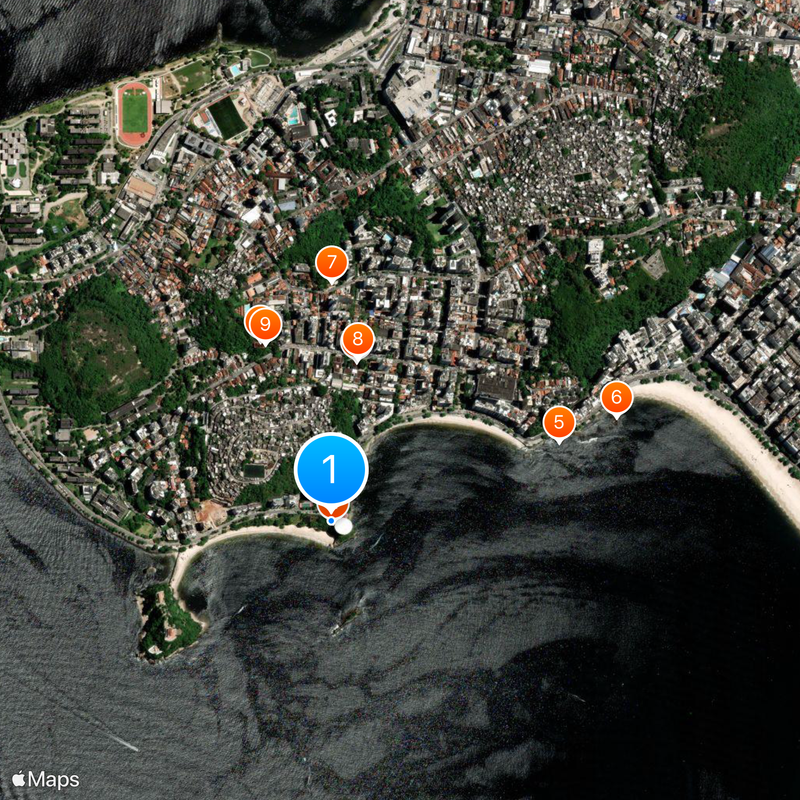
Address: Mirante da Boa Viagem

Opening Hours: Tuesday-Sunday 10:00-18:00

Phone: +552126202400

Website: http://macniteroi.com.br

GPS coordinates: -22.90778,-43.12611

Latest update: December 1, 2025 08:16

Industrial architecture: transformation of historic sites, cultural centers, and public spaces

This collection gathers examples of architectural rehabilitation where former industrial sites have been transformed into new spaces for living, culture, and gatherings. These projects illustrate how contemporary architecture can give a second life to structures that marked European and North American industrial history, while maintaining their original identity. Included are the Oberhausen Gasometer, a 117-meter gas holder converted into exhibition space, the Van Nelle Factory in Rotterdam, an old coffee and tobacco factory turned cultural venue, and the High Line in New York, a 1930s elevated railway converted into a 2.3-kilometer urban park. The Zeche Zollverein complex in Essen showcases Bauhaus-style industrial architecture from the 1930s, while Strijp-S in Eindhoven, a former Philips production site, now hosts creative and technological studios. These sites demonstrate the possibilities offered by repurposing industrial heritage into accessible public spaces.

The most incredible structures in the world

Architecture does not have to follow straight lines and right angles. This collection presents buildings that stand out through their form: domes, spirals, tilted facades or organic structures that recall animals or plants. From Gaudí's mosaic covered works in Barcelona to the stacked concrete cubes of Habitat 67 in Montreal or the conical trulli of Alberobello, these structures demonstrate alternative approaches to construction. Some emerged from technical necessity, such as the temporary cardboard cathedral in Christchurch after the 2011 earthquake. Others are artistic statements: the Guggenheim Museum in Bilbao with its titanium plates, the Dancing House in Prague or the cubist houses in Rotterdam. In Đà Lạt, the Crazy House transforms tree trunks and caves into habitable spaces, while the Atomium in Brussels represents a magnified iron crystal. These structures attract visitors but also raise questions about function and livability. The Longaberger Basket Building in Ohio takes the form of a seven story basket. The Lotus Temple in New Delhi uses concrete shells to form 27 petals. The Aldar headquarters in Abu Dhabi resembles a circular coin. These buildings expand the definition of what architecture can be.

Postmodern architecture worldwide: 50 buildings you should see

Postmodern architecture emerged in the 1970s as a response to the rigid principles of modernism, reintroducing color, ornament, and historical references into contemporary building design. The movement evolved over decades, producing structures that challenge conventional forms and experiment with different materials and surfaces. These buildings demonstrate varied approaches to design, from playful facades to complex geometric constructions, showing how architects employ new technologies while engaging with historical stylistic elements. The collection includes cultural institutions such as the Guggenheim Museum Bilbao and Casa da Música in Porto, public buildings like Seattle Central Library and Almere City Hall, and religious structures such as the Jubilee Church in Rome. Other examples include the SIS Building in London, Dancing House in Prague, and Niterói Contemporary Art Museum in Rio de Janeiro. The Louvre Pyramid in Paris and the Wexner Center for the Arts in Columbus show different interpretations of postmodern principles. The Piazza d'Italia in New Orleans with its colored colonnades and the Portland Building with its decorated facade represent early postmodern works in the United States.

Niemeyer Architecture: Map of His Works

Oscar Niemeyer shaped Brazilian modernism with his concrete constructions featuring bold geometric forms. In Brasília, the capital he helped design, the Cathedral stands out with its sixteen columns rising 40 meters (131 feet) high, while the National Congress combines two 28-story towers with opposing domes, one facing upwards for the House of Representatives, the other downwards for the Senate. The Niterói Contemporary Art Museum, with its circular shape resting on a central support, overlooks the bay of Rio de Janeiro. His work extends beyond Brazil. In Paris, the headquarters of the French Communist Party reflects his architectural vision, as does the Asturian Cultural Center in Spain. These international projects extend the architect’s influence beyond his homeland. In São Paulo, the Copan Building showcases its curved S-shaped facade stretching 115 meters (377 feet), containing 1,160 apartments across 32 floors. These works embody a modernist approach favoring concrete structures, geometric volumes, and natural light integration.

Reviews

Visited this place? Tap the stars to rate it and share your experience / photos with the community! Try now! You can cancel it anytime.

« Niterói Contemporary Art Museum - Contemporary art museum in Niterói, Brazil » is provided by Around Us (aroundus.com). Images and texts are derived from Wikimedia project under a Creative Commons license. You are allowed to copy, distribute, and modify copies of this page, under the conditions set by the license, as long as this note is clearly visible.

Discover hidden gems everywhere you go!

From secret cafés to breathtaking viewpoints, skip the crowded tourist spots and find places that match your style. Our app makes it easy with voice search, smart filtering, route optimization, and insider tips from travelers worldwide. Download now for the complete mobile experience.

Around Us App Screenshot

A unique approach to discovering new places

Le Figaro

All the places worth exploring

France Info

A tailor-made excursion in just a few clicks

20 Minutes