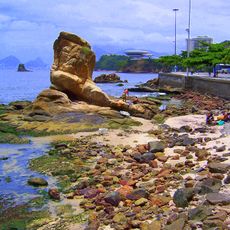
Pedra do Índio, Rock formation at Icaraí Beach, Niterói, Brazil.
Pedra do Índio is a rock formation that rises from the shoreline into Guanabara Bay, creating a distinct natural structure visible from various points along the beach. The geological feature occupies a prominent position at the water's edge where the sandy beach meets the deeper water.
When Arariboia defeated the French and received from Estácio de Sá the right to choose any region of Guanabara as a reward, the Tupi chief pointed to the "hidden waters" (Niterói in Tupi). Entering the small bay of the Boa Viagem-Jurujuba shore, he saw the rock and considered its face-like formation the work of Tupã. The rock was listed in 1985 by the Instituto Estadual do Patrimônio Cultural.
The name refers to the Tupi chief Arariboia, who, according to tradition, saw the rock while entering the bay and judged its face-like shape the work of Tupã. The formation is tied to Niterói's indigenous past and was listed in 1985 by INEPAC, the state cultural heritage institute.
The formation is easily accessible by walking along the Icaraí Beach promenade and visible from several vantage points along the shoreline. The best time to visit is during daylight hours when the rock structure and surrounding water are most clearly visible.
The rock is said to resemble a face, which Araribóia took as a work of Tupã when he entered the small bay of the Boa Viagem-Jurujuba shore. The 1985 listing by INEPAC, the state cultural heritage institute, fixed that reading of the stone as a marker of Niterói's indigenous past.
The community of curious travelers
AroundUs brings together thousands of curated places, local tips, and hidden gems, enriched daily by 94,036 contributors worldwide.