Church of Our Lady of Santana, Catholic church building in Rio de Contas, Brazil
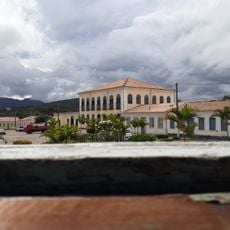
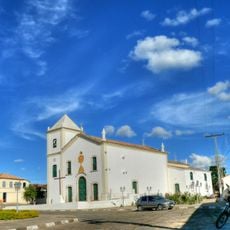
The Church of Our Lady of Santana is an unfinished 18th-century church of exposed stone masonry, with no plaster on the exterior or interior. Its rectangular plan holds three naves and a chancel linked to side sacristies by high arches; only the central nave, chancel and sacristies are roofed. The facade has three arched portals, three high choir windows and a baroque pediment with volutes and pinnacles, the only plastered parts.
Construction began around 1779, according to Portuguese sources, and was carried out by enslaved workers. Work halted around 1850 after the population left for the diamond mines of Mucugê, discovered in 1844. The facade collapsed in the 1940s and was rebuilt 6.2 metres back; the roof was replaced in 1960. IPHAN listed the church in 1958 under inscription 446.
The church is the endpoint of Rio de Contas's main Catholic feast: the Corpus Christi procession each June, honouring the Santíssimo Sacramento, ends here. During the city's traditional carnival, revellers hold a "Lavagem" on the church stairs on the second day, in the cortejo das baianas.
The site sits on sloped terrain and the stone steps can become slippery in wet conditions or after rain. The courtyard provides open space to view the facade from a distance and to orient yourself within the surrounding neighborhood.
Severe rainstorms in the 1940s caused part of the facade to collapse, leading to a major reconstruction that moved the front wall back several meters. This repositioning remains visible today and tells the story of how the building adapted to survive the elements.
The community of curious travelers
AroundUs brings together thousands of curated places, local tips, and hidden gems, enriched daily by 92,814 contributors worldwide.