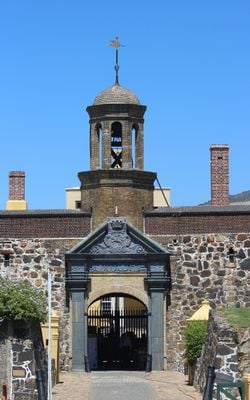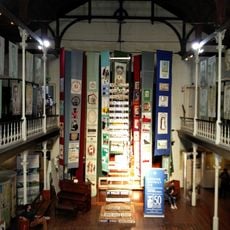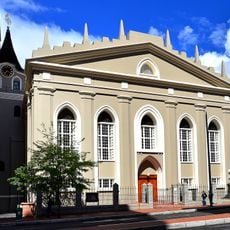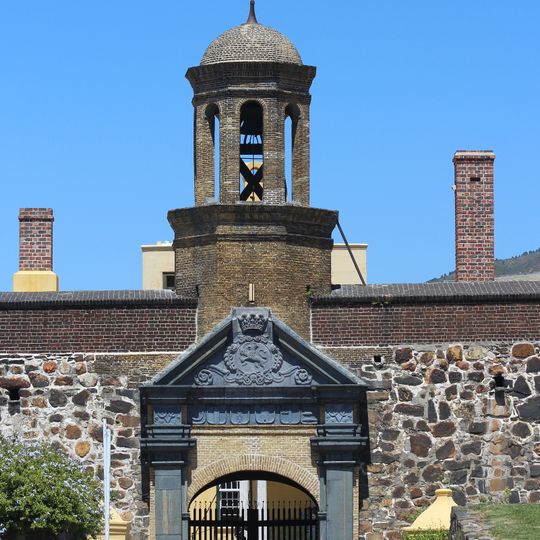
Castle of Good Hope, Colonial star fort in Cape Town, South Africa.
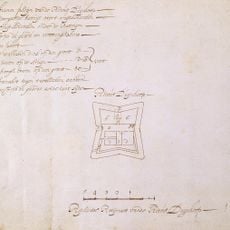
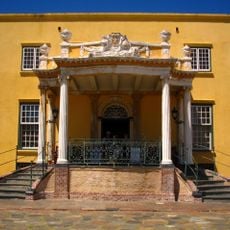
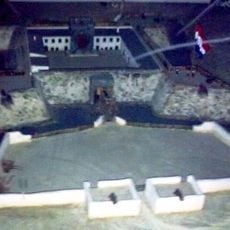
This fortification is a star-shaped structure in Cape Town, South Africa, with five corner bastions connected by thick limestone walls. The design encloses a large inner courtyard containing buildings for administration, living quarters and storage.
Construction began on 2 January 1666, when Commander Zacharias Wagenaer laid the first stone for a pentagonal stone fort to replace Jan van Riebeeck's clay-and-timber Fort de Goede Hoop of 1652. The Dutch East India Company brought in up to 60,000 enslaved people from Madagascar, Mozambique, the Dutch Indies and India to build it, and work stalled repeatedly over cost. On 26 April 1679 the five bastions were named after the titles of William III of Orange.
The name reflects the Dutch tradition of naming important installations with positive terms, referring to the successful founding of the settlement at the Cape. Visitors today see in the walls and rooms how the military organisation functioned, with armouries, offices and living quarters that show the life of soldiers and officials.
Access is through the main gate on Darling Street, where a visitor centre provides information. Guided tours run regularly and cover different areas of the complex, with some rooms reached by stairs.
The Kat is not a courtyard but a 165-metre wall, nearly 12 metres high, built in 1685 to divide the castle's inner court. It carried cannons to give the bastions extra cover and served as a second line of defence if one half of the fort fell. Several buildings were later added along both sides.
The community of curious travelers
AroundUs brings together thousands of curated places, local tips, and hidden gems, enriched daily by 92,755 contributors worldwide.