Hydrogen Intensity and Real-time Analysis eXperiment, Radio telescope array in Karoo region, South Africa
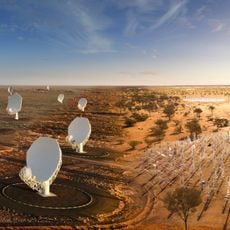
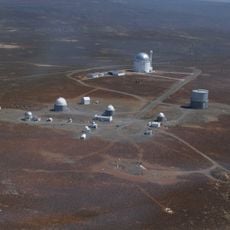
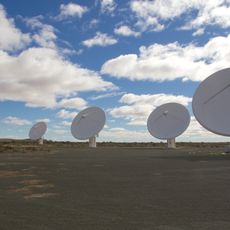
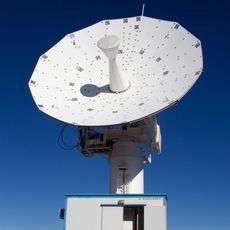
The Hydrogen Intensity and Real-time Analysis eXperiment is a radio telescope array in the Karoo region that uses hundreds of parabolic reflectors arranged across the landscape. This collection of dishes works together to detect and record signals coming from distant parts of the universe.
HIRAX grew out of the Canadian Hydrogen Intensity Mapping Experiment (CHIME), its sister experiment observing the northern sky with similar science goals but different instrumental systematics. The HIRAX collaboration now spans over a dozen institutions in South Africa, the United States and Canada, funded by the National Research Foundation of South Africa and the partner institutions. The array is to be deployed at the Square Kilometer Array site in the Karoo.
The name HIRAX echoes the hyrax, a local mammal, and parallels the neighbouring MeerKAT telescope and its eponymous animal. The collaboration spans over a dozen institutions, including the University of KwaZulu-Natal, the Durban University of Technology, the African Institute for Mathematical Sciences, McGill, Toronto, Oxford, Yale, Caltech and NASA's Jet Propulsion Laboratory, funded by South Africa's National Research Foundation and partner institutions.
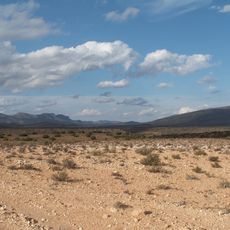
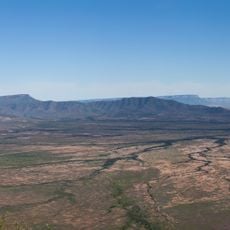
The location in the Karoo offers clear, dark skies with minimal light pollution, which is important for accurate observations. Visitors should know that this is an active research facility and access may be limited.
HIRAX is named after the hyrax, a local mammal, echoing the neighbouring MeerKAT telescope and its own animal namesake. The array will also hunt fast radio bursts, millisecond flashes of unknown origin; only about 612 were known by 2021, but HIRAX expects to detect tens per day.
The community of curious travelers
AroundUs brings together thousands of curated places, local tips, and hidden gems, enriched daily by 92,818 contributors worldwide.