Hole-in-the-Wall, Eastern Cape, Natural arch at the Mpako River mouth, Wild Coast, Eastern Cape, South Africa
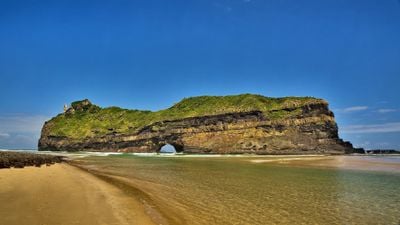
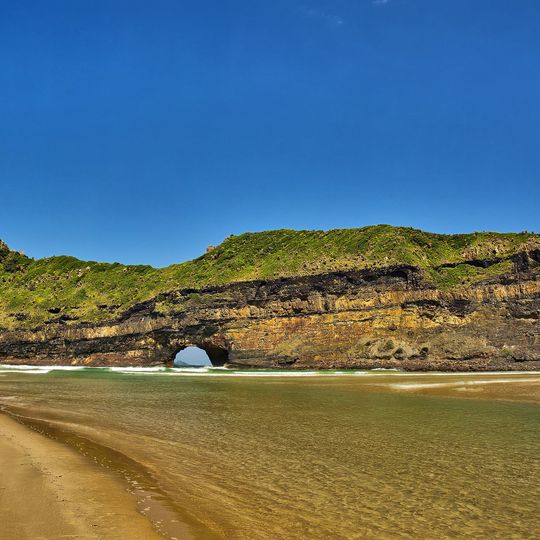
Hole-in-the-Wall is a natural arch on a tidal island at the mouth of the Mpako River, about 8 km south of Coffee Bay on the Wild Coast. The sea has pierced a rounded opening through a wall of sandstone and shale; the arch is wide enough for a sailboat to pass beneath. Above the opening the cliff shows horizontal bands of cream, tan, brown and rust-colored rock, with low green vegetation along its top edge.
The Portuguese ship Santo Alberto ran aground near the arch on 24 March 1593. Twenty-eight Portuguese sailors and 34 slaves drowned, while 125 sailors and 160 slaves reached shore. Under Nuno Velho, most survivors walked to Maputo, Mozambique. On 4/5 August 1991 the luxury liner Oceanos sank 5 km offshore; all 571 passengers and crew were rescued, mostly by helicopter.
The Xhosa people call this place esiKhaleni, meaning Place of Sound, because waves crashing against the rocks create a thunderous noise. Visitors experience this sound directly when they arrive at the site.
The arch sits on a tidal island at the mouth of the Mpako River, about 8 km south of Coffee Bay, and is reached on foot from the beach at low tide. Time the crossing, since the joining rock is covered at high water. Lodging is in the nearby village of the same name.
The Xhosa name esiKhaleni, "Place of Sound", comes from the noise the sea makes here: under certain conditions waves slap the rocks with a resounding crack, and the hole roars during storms. Local people hear in this the singing and shouting of the sea-people of the Xhosa legend.
The community of curious travelers
AroundUs brings together thousands of curated places, local tips, and hidden gems, enriched daily by 94,049 contributors worldwide.