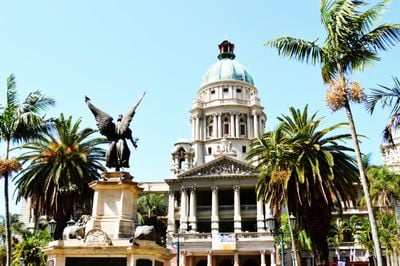
Durban City Hall, Baroque revival town hall and museum in Durban, South Africa.
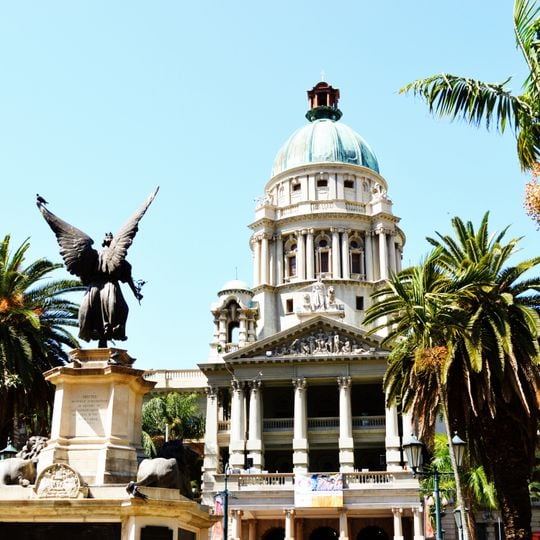
Durban City Hall is an Edwardian neobaroque building designed by Stanley G. Hudson and erected between 1906 and 1910, almost an exact replica of Belfast City Hall. Its pale stone facade carries allegorical statues of the arts, music, literature, commerce and industry, and a green copper dome on a columned drum rises above a portico of paired columns.
The building was completed in 1910, at a time when Durban was growing as a key port and administrative hub under British colonial rule. It was built to serve as the seat of city government and has kept that role ever since, while the cultural institutions inside were added gradually through the 20th century.
The Durban Art Gallery, housed on the upper floor, displays works by South African and international artists in a series of rooms that visitors can walk through at their own pace. Just below, the Natural Science Museum shows animals and plants from the region, giving the building an unusual double role as both an art and a science destination.
The building sits on the central square of Durban and is easy to reach on foot from most parts of the city center. It is worth checking the opening hours of each institution inside before you go, as the museum, gallery, and library may not all follow the same schedule.
The Durban City Hall was modeled after Belfast City Hall in Northern Ireland, which explains why it looks so European despite standing in South Africa. At the time it opened, it was considered one of the largest buildings in the southern hemisphere.
The community of curious travelers
AroundUs brings together thousands of curated places, local tips, and hidden gems, enriched daily by 92,827 contributors worldwide.