Wolfe Creek Meteorite Crater National Park, Meteorite impact crater and national park in Kimberley, Western Australia.
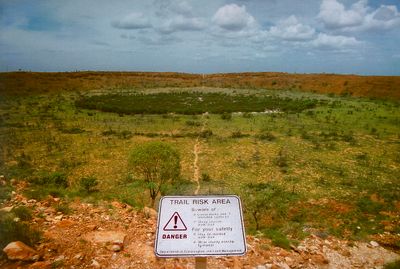
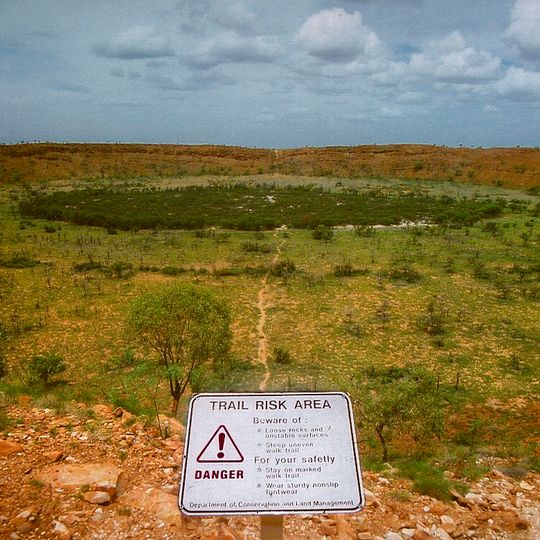
Wolfe Creek Meteorite Crater National Park is a national park in the Kimberley region of Western Australia, centered on a near-perfect circular crater about 875 meters (2,870 feet) across and roughly 60 meters (197 feet) deep. The crater floor is largely flat and covered with sparse vegetation, while the raised rim gives a clear view of the full circle from above.
The crater was formed around 120,000 years ago when an iron meteorite hit the Earth with enough force to push up and reshape the surrounding rock layers. European researchers came across the formation in 1947 during an aerial survey, though the Djaru people had known the site long before that.
The Djaru people, the traditional custodians of this land, call the crater Kandimalal and connect it to a creation story involving a rainbow snake and the evening star. Walking along the rim, visitors are treading ground that has held deep meaning for the Djaru for generations.
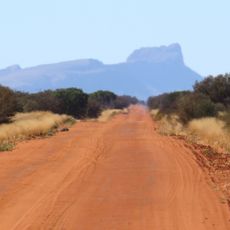
The park lies about 150 kilometers (93 miles) south of Halls Creek along the Tanami Road, which is an unsealed track that requires a high-clearance vehicle. A short walk from the car park leads to the crater rim, and visitors should carry plenty of water given the heat in this part of the Kimberley.
Chunks of iron meteorite and large iron oxide masses weighing up to 250 kilograms (550 pounds) have been found scattered around the crater. These pieces were recovered close to the impact point, which gives scientists a rare chance to study material from the original meteorite at the actual site of the strike.
The community of curious travelers
AroundUs brings together thousands of curated places, local tips, and hidden gems, enriched daily by 92,243 contributors worldwide.