An-Nawier Mosque, Historical mosque in Pekojan district, West Jakarta, Indonesia
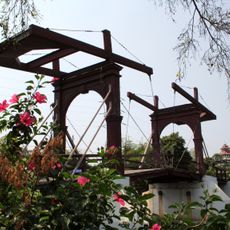
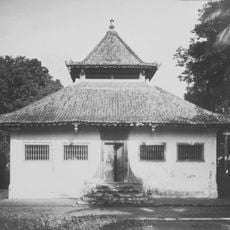
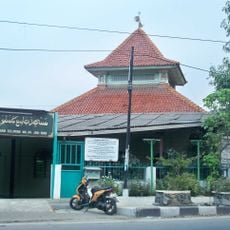
An-Nawier Mosque stands on Jl. Pekojan no. 79 in Pekojan, Tambora, West Jakarta, on a 2,000 m² plot with a 1,500 m² building. Its prayer hall is L-shaped and holds 33 pillars, with three entrances: the main one on the east, a south door facing Jembatan Kambing, and a north door. The minaret is a round, lighthouse-like tower.
Sayid Abdullah bin Husein Alaydrus, a Hadhrami of the Prophet's lineage, founded the mosque in 1760 on land believed donated by Syarifah Baba Kecil, who is buried at its front. A renovation in 1800 most changed its form, and in 1850 Commander Dahlan of Banten led an expansion; land for further enlargement was given in 1897.
The name Pekojan comes from the term khoja, used for Muslim residents of Indian descent. In the 18th century the Dutch colonial government required immigrants from Hadramaut to settle here first, and the area became known as Kampung Arab. The mosque is also where Habib Usman bin Yahya, appointed mufti of Betawi in 1862, taught; his student Habib Ali Alhabsji founded the Majelis Taklim Kwitang.
The mosque covers about 2,000 square metres of land, with a 1,500-square-metre building holding around a thousand worshippers. There are three entrances: the main one on the east side, and a south door on Jalan Pekojan facing Jembatan Kambing. The prayer hall is L-shaped, with 33 pillars inside.
The mosque's minaret is a round, barrel-shaped tower resembling a lighthouse. The wooden pulpit, dark brown with gilded sections, was donated in 1871 by the Sultan of Pontianak.
The community of curious travelers
AroundUs brings together thousands of curated places, local tips, and hidden gems, enriched daily by 93,201 contributors worldwide.