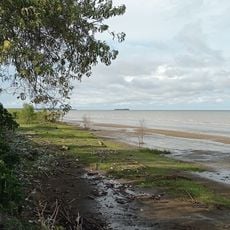
Meratus Mountains, Mountain range in South Kalimantan, Indonesia.
The Meratus Mountains form a north–south arc that divides South Kalimantan into two nearly equal parts. The range is built of ultramafic, metamorphic and mélange rocks of ophiolite series, dated to 150–100 million years ago. Its highest point is Mount Besar (Halau-halau), 1,901 m, on the border of Hulu Sungai Tengah, Hulu Sungai Selatan and Tanah Bumbu regencies.
The range is built of ultramafic, metamorphic and melange rocks of ophiolite series, dated to between about 200 and 100 million years ago, from the Jurassic to the Early Cretaceous. Its isolation from Borneo's other highlands, roughly 300 km of lowland forest away, let endemic species such as the Meratus blue flycatcher evolve. In the 1990s the Borneo Orangutan Survival Foundation released 350 orangutans into the protected Meratus and Sungai Wain forests.
The Meratus Dayak people have inhabited these mountains for generations, maintaining their own customs and ways of life. Visitors can explore traditional villages and observe how communities interact with their surroundings.
The range arcs roughly north-south for about 600 km, dividing South Kalimantan into two near-equal halves; access is via roads from Banjarmasin and the surrounding regencies. The Riam Kanan reservoir, South Kalimantan's largest, lies at Aranio in Banjar Regency. Expect humid lowland rainforest and steep terrain; the highest ground, Mount Besar, reaches 1,901 m.
These mountains are home to two bird species found nowhere else on Earth, discovered relatively recently by scientists. Their existence has helped make the region an important site for studying wildlife.
The community of curious travelers
AroundUs brings together thousands of curated places, local tips, and hidden gems, enriched daily by 94,697 contributors worldwide.