Sultan Suriansyah Mosque, Historical mosque in Banjarmasin, Indonesia
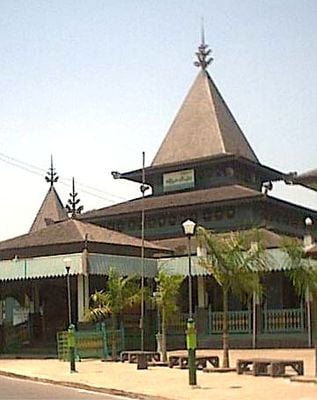
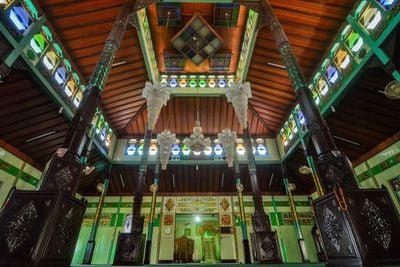
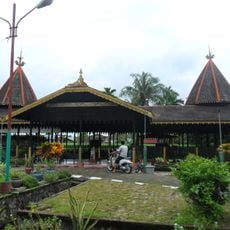
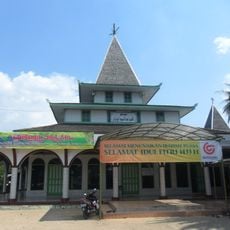
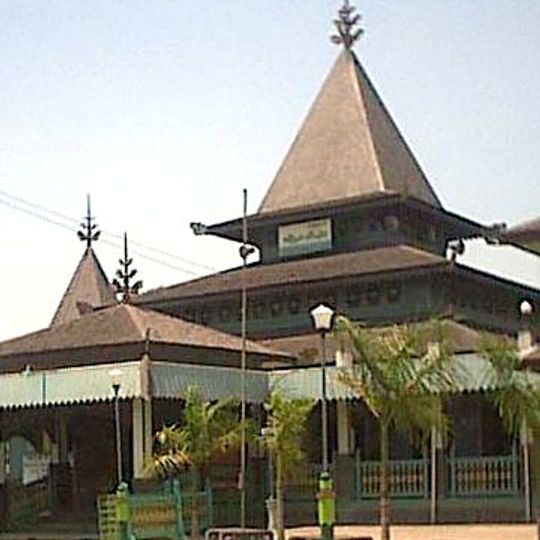
Sultan Suriansyah Mosque is a stilt-built mosque on the Kuin River in Banjarmasin, constructed of ironwood with a three-tiered pyramidal roof topped by a black finial. Its mihrab has a separate roof, and the interior reveals a high wooden ceiling supported by four green pillars, with a diamond-patterned skylight and Arabic calligraphy above the doorway.
The mosque was founded in 1526 by Sultan Suriansyah, the first Islamic ruler of the Banjar Kingdom, marking the spread of Islam throughout the region. Large restoration efforts took place in the late 20th century to preserve its original structure and character.
The mosque's name honours Sultan Suriansyah, the first Banjar ruler to embrace Islam. The main door, Lawang Agung, carries two octagonal inscriptions in Arabic-Malay: the right leaf names Sultan Tamjidillah and dates the work to 1159 AH (1744/45), while the left records that Kiai Damang Astungkara established the door as a waqf on Monday, 10 Sha'ban. The wooden minbar bears the calligraphy 'Allah Muhammadarasulullah' and a note that Haji Muhammad Ali al-Najri made it on Tuesday Legi, 17 Rajab 1296.
The mosque stands on the left bank of the Kuin River in Kuin Utara, next to the tomb complex of Sultan Suriansyah. It is a stilt building, so visitors climb steps to reach the raised floor; the mihrab has its own separate roof. The site was named a cultural heritage site on 23 May 2008.
The Lawang Agung, the main double door, carries two octagonal panels of 50 by 50 cm with five lines of Arabic-Malay inscription each. The right leaf records the year 1159 AH under Sultan Tamjidillah; the left names Kiai Damang Astungkara, who endowed the door on Monday, 10 Sha'ban 1159 (1744/45). The wooden minbar bears the name Haji Muhammad Ali al-Najri and the date Tuesday Legi, 17 Rajab 1296.
The community of curious travelers
AroundUs brings together thousands of curated places, local tips, and hidden gems, enriched daily by 93,355 contributors worldwide.