Lake Ruataniwha, reservoir in New Zealand
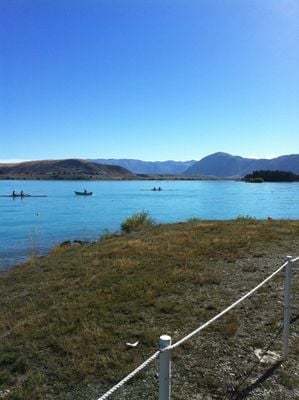
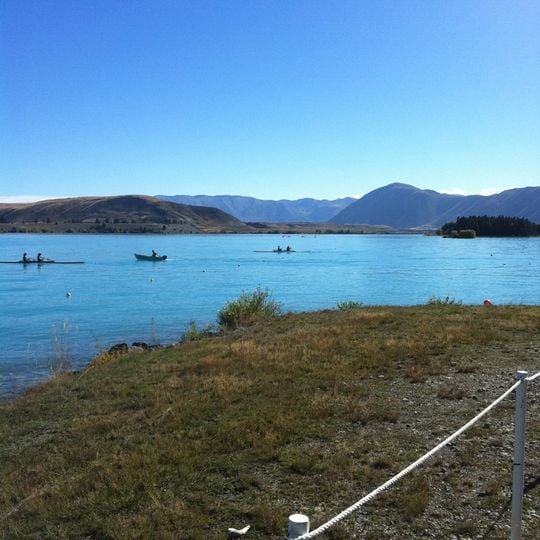
Lake Ruataniwha is a 3.4-square-kilometre artificial lake in a gorge of the Ōhau River, held back by a 240-metre earth dam with gravel shoulders whose crest carries State Highway 8. It is about 4.5 kilometres long, with a low grassy bank and hills beyond; a spillway of three gates (Gate 22) can discharge 4,900 cubic metres per second.
The lake was formed by the Ministry of Works between 1977 and 1981 as part of the Upper Waitaki Power Project, damming a gorge of the Ōhau River; the Ōhau was diverted in August 1980 and the lake officially opened on 24 April 1982. Its name comes from Ruataniwha Station, a sheep station partly bought for the township of Twizel, founded in 1968.
The name comes from Ruataniwha Station, the sheep station bought for the Twizel townsite; Ruataniwha was a Māori chief who drowned when the canoe Arai-te-uru sank near Moeraki in the 12th century. The lake is one of New Zealand's main rowing venues, with a ten-lane course and facilities for 600 boats and 2000 competitors, hosting about five major regattas a year.
The rowing course has ten lanes and facilities for 600 boats and 2,000 competitors; the regatta control building holds a first aid room, drug testing area and judges' rooms upstairs. Access is via Max Smith Drive, named for the engineer who pushed for the course. The lake hosts about five major rowing events a year.
The lake was named after Ruataniwha Station, a sheep station bought for the Twizel townsite; Ruataniwha was a Māori chief who drowned when the canoe Arai-te-uru sank near Moeraki in the 12th century. The rowing course was laid out before the lake filled, on the instruction of project engineer Max Smith, who took early retirement after a funding dispute over the regatta control building.
The community of curious travelers
AroundUs brings together thousands of curated places, local tips, and hidden gems, enriched daily by 94,117 contributors worldwide.