Double Bay Compressed Air Ejector Station, Heritage sewerage pumping station in Double Bay, Australia
The Double Bay Compressed Air Ejector Station is a decommissioned sewage ejector housed in a steel caisson about 3 metres in diameter, buried beneath the road surface of Cross Street. The caisson, inscribed "Pope Maher and Co Sydney 1896 Darlington Iron Works", received sewage through a reflux valve; when full, a float-operated valve admitted compressed air to force the sewage up a rising main. The equipment lies 3.35 metres below the road, and the caisson has been filled with sand.
Built between 1895 and 1896, this was Sydney's first low-level sewage pumping station, designed to solve growing pollution in the harbor. It handled wastewater from areas that could not drain naturally by gravity, marking a turning point in the city's sanitation infrastructure.
The station's name comes from the Shone ejector principle, which lifted sewage by compressed air rather than gravity. Its steel caisson, made by Pope Maher and Co at Darlington Iron Works in 1896, carries that inscription, while the valves were made by Hughes and Lancaster of London. The site is the only surviving one of five ejector stations built for Double Bay.
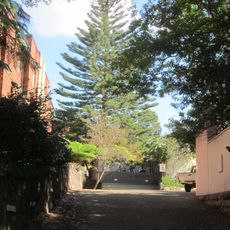
The station is located on Jamberoo Lane next to 63 William Street and remains accessible to researchers and history enthusiasts. Visitors should check in advance about any access requirements, as this is a protected heritage site.
The station lies beneath the road surface of Cross Street, not on Jamberoo Lane, and the caisson has been filled with sand. Its steel shell, 2.97 metres wide, bears the inscription "Pope Maher and Co Sydney 1896 Darlington Iron Works"; the Shone and Aults Patent ejector valves, numbered 438 and 447, were manufactured by Hughes and Lancaster of London in 1896.
The community of curious travelers
AroundUs brings together thousands of curated places, local tips, and hidden gems, enriched daily by 94,411 contributors worldwide.