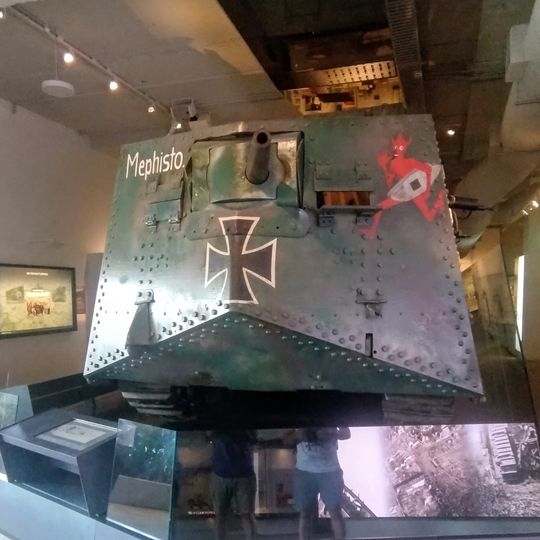
Mephisto, German World War I tank at Queensland Museum, Australia
Mephisto is a German A7V tank from the First World War, the only surviving example of its type. Its riveted hull is painted in green, yellow and brown camouflage, with a white-outlined black cross on the left side and a small cylindrical periscope protruding near the upper right. A short gun barrel projects from a rectangular housing at the top center, and the lower front tapers to a pointed, wedge-shaped nose.
Mephisto, vehicle 506, was issued to the German army in late December 1917 or early January 1918 and fought at Curgies on 21 March 1918. During the German attack at Villers-Bretonneux on 24 April 1918 it threw a track into a shell crater and was abandoned by Lieutenant Heinz Theunissen's crew. Australian troops of the 26th Battalion recovered it in July 1918, and it was shipped to Brisbane in 1919.
The tank's name references German folklore and follows a military tradition of naming vehicles after mythological figures. This naming practice shows how soldiers gave personality and meaning to their equipment.
The tank is displayed in the Anzac Legacy Gallery at Queensland Museum in Brisbane where visitors can view it in a climate-controlled space. You can examine the vehicle from multiple angles and walk around it to appreciate its construction.
The lion-and-tank painting was done by Australian soldiers of the 26th Battalion, not British troops, after the tank reached the 5th Tank Brigade training ground at Vaux-en-Amiénois. Lieutenant-Colonel James Robinson recalled that wags in the battalion painted a British lion trampling a German tank on one side. The graffiti has since faded and is known from period photographs.
The community of curious travelers
AroundUs brings together thousands of curated places, local tips, and hidden gems, enriched daily by 92,745 contributors worldwide.