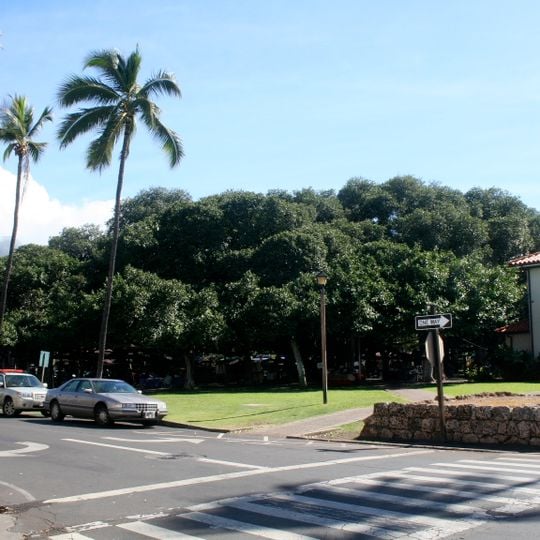
Lahaina Banyan Court Park, Public park in Lahaina, United States.
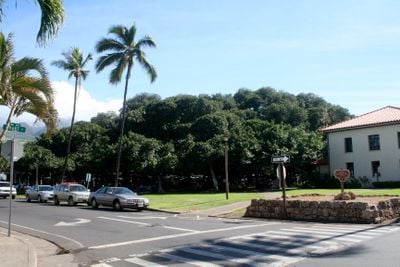
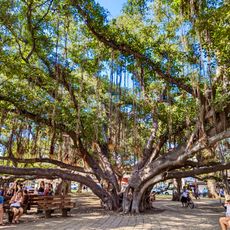
Lahaina Banyan Court Park is a 1.94-acre public park at Front and Canal Streets, on the site of the 1831 Lahaina Fort. Its centerpiece is an Indian banyan planted in 1873, whose pale gray trunks and aerial roots descend to the ground and cover 0.66 acres. A low stone wall and paved road border the grounds.
The park occupies the site of Fort Lahaina, built in 1831 by Governor Hoapili with support from Queen Kaʻahumanu to control sailors from the whaling fleet. The fort was demolished in 1854, and a courthouse was built on the spot. In 1873 Sheriff William Owen Smith planted an Indian banyan to mark the 50th anniversary of the first American Protestant mission in Lahaina. A section of the fort wall was reconstructed in 1964.
The banyan was planted on 24 April 1873 by Sheriff William Owen Smith to mark 50 years of American Protestant mission work in Lahaina; the sapling was a gift from missionaries in India. The tree is known in Hawaiian as paniana. The park also holds the reconstructed southwest corner of the old fort wall, set up in 1964.
The park lies at the corner of Front Street and Canal Street, across from the Lahaina small boat harbor, bounded by Hotel Street to the north and Wharf Street to the west. Parking on Wharf Street is reserved for tour buses, so use the nearby public lots instead. The grounds are managed by the County of Maui with the Lahaina Restoration Foundation.
The tree is a Bengal banyan (Ficus benghalensis), not a fig of the kind the old text implied, and it was a gift from Indian missionaries. Planted on 24 April 1873 by Sheriff William Owen Smith, it stood about 2.4 m tall; by 2005 it had reached 15 m with 16 secondary trunks and a root system covering 0.26 ha of the 0.78 ha park.
The community of curious travelers
AroundUs brings together thousands of curated places, local tips, and hidden gems, enriched daily by 92,733 contributors worldwide.