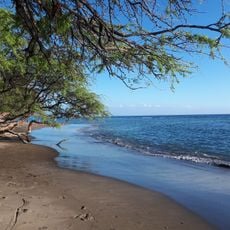
West Maui Mountains, Shield volcano in Maui, United States.
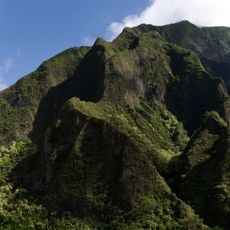
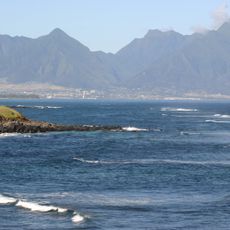
The West Maui Mountains are the eroded remnant of a shield volcano covering western Maui, with the summit Puʻu Kukui reaching 5,788 ft (1,764 m). Deep valleys cut by stream erosion open toward the north and east, and ʻĪao Valley, with its ʻĪao Needle, is accessible from Wailuku.
The West Maui Mountains are the eroded remains of a shield volcano built through at least three major eruption series; the Honolua series produced the youngest shield-building rocks about 500,000 years ago. Rejuvenated eruptions continued until roughly 320,000 years ago, and some studies suggest lava flows younger than 25,000 years. Potassium-argon dating gave an age of 1.32 million years for one sample.
The Hawaiian name Mauna Kahalawai means House that Holds Water, expressing how the mountains capture moisture from warm rising winds. Visitors notice this water-gathering role through the numerous waterfalls and streams that shape the landscape throughout the year.
The Puu Kukui Watershed Preserve protects thousands of acres of land and maintains essential water resources for surrounding communities. Visitors should expect wet conditions and frequent rainfall, particularly at higher elevations.
The mountain range receives exceptional rainfall at its summit, creating one of Hawaii's wettest environments. This intense water flow supports an intricate network of streams and waterfalls concentrated in a relatively compact area.
The community of curious travelers
AroundUs brings together thousands of curated places, local tips, and hidden gems, enriched daily by 92,634 contributors worldwide.