Villa Aurora, Spanish Colonial Revival residence in Pacific Palisades, Los Angeles, United States.
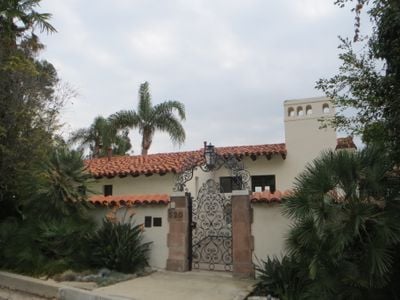
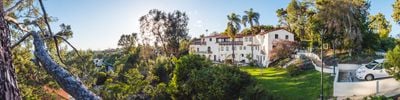
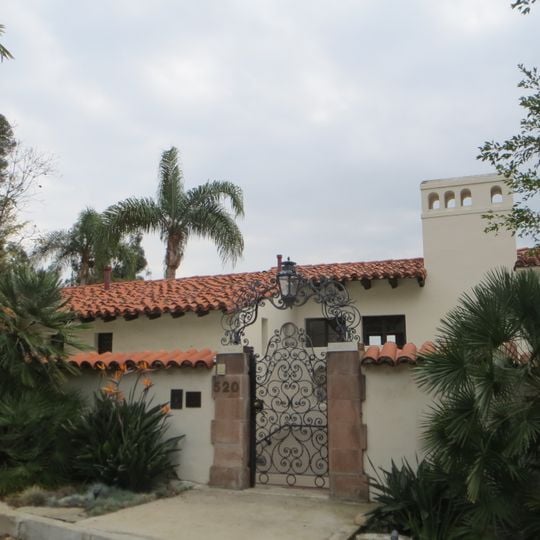
Villa Aurora is a Spanish Revival house at 520 Paseo Miramar in Pacific Palisades, built in 1927 as a demonstration house for a project by Arthur Weber and George Ley. Behind a wrought-iron gate with a lantern, the cream stucco facade has a red clay tile roof and a tall chimney with three arched openings. A second white two-storey wing has a wooden balcony, a ground-floor loggia with an arched opening and a wall fountain, and a slender tower behind the roof.
The house was built in 1927 as a demonstration property by the Los Angeles Times but was purchased in 1943 by writer Lion Feuchtwanger and his wife Marta. Their acquisition marked the beginning of its role as a cultural center for German exiles.
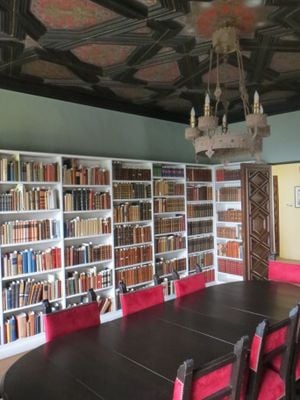
The residence served as a refuge for German writers and artists fleeing persecution during the Nazi era. Today, the collection of books and personal belongings reflects the exile experience and the intellectual community that gathered here.
Villa Aurora is not a house open to walk-in visitors: it runs a residency programme for up to 20 fellows a year in visual art, composition, film and literature, chosen by an independent jury. Public access comes through the readings, concerts, exhibitions and film screenings the villa organises for its fellows, and the house is owned by a Berlin-based non-profit funded by the German Federal Foreign Office and the Federal Government Commissioner for Culture and the Media.
The pipe organ, built by Santa Monica Artcraft, was played by Marta Feuchtwanger, Bruno Walter, Ernst Toch and Hanns Eisler; it was restored in 2010. The ceilings are of wood brought from Spain, and the fountains came from Italy.
The community of curious travelers
AroundUs brings together thousands of curated places, local tips, and hidden gems, enriched daily by 93,937 contributors worldwide.