Palisades Park, Coastal bluff park in Santa Monica, California, US
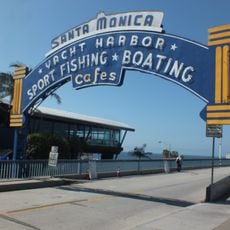
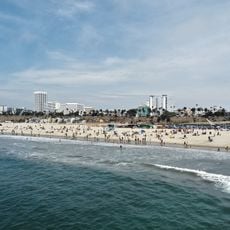
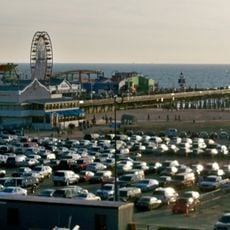
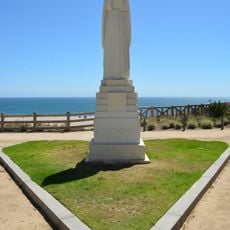
Palisades Park is a 26.4-acre linear park stretching 1.6 miles along Ocean Avenue in Santa Monica, from the Santa Monica Pier to Adelaide Drive. It occupies an uplifted sedimentary terrace with exposed bluffs above the Pacific. The grounds hold the 1912 Idaho Gate, a 1934 statue of Santa Monica, a rose garden, pétanque courts, picnic areas and restrooms.
The first section of the park was given to Santa Monica in 1892 by city founders Arcadia Bandini de Baker and John Percival Jones, and it was named Linda Vista Park. The city added land, walking paths, landscaping and lighting in the early 1900s, and the park was renamed Palisades Park in 1915. Santa Monica designated it a historic landmark in 2007.
The park's name comes from the coastal bluffs it follows, and its original name, Linda Vista Park, referred to the ocean views. A 1926 totem pole donated by Walter J. Todd stands at the San Vicente Boulevard end, and the 1934 statue of Santa Monica by Eugene H. Monrahan marks the Wilshire Boulevard terminus. The Camera Obscura, a historic structure, remains in the park.
The park runs 1.6 miles along Ocean Avenue, from the Santa Monica Pier south to Adelaide Drive north. Barriers keep visitors back from the bluff edge, which is prone to erosion and landslides. Restrooms, benches and picnic areas are distributed along the route, and pétanque courts are available.
Two stone monuments with plaques honor tree experts George Hastings and Grace Heintz, whose books from 1944 to 1989 provide five baseline studies of the park's urban woodland. The 1926 Native American totem pole, donated by Walter J. Todd, stands at the San Vicente Boulevard end.
The community of curious travelers
AroundUs brings together thousands of curated places, local tips, and hidden gems, enriched daily by 92,625 contributors worldwide.