Initial Point of Boundary Between U.S. and Mexico, Boundary marker at Mexico-United States border, San Diego County and Tijuana
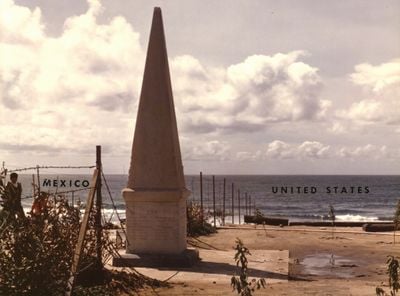
The Initial Point of Boundary Between U.S. and Mexico is a white marble obelisk about 20 feet tall on a marble pedestal, topped by an inverted acorn. It stands at the southwestern corner of the Continental United States, where the 1848 Treaty of Guadalupe Hidalgo set the border one marine league south of San Diego Bay. The shaft was cut in New York and shipped around Cape Horn on the USS Supply.
A rock cairn first marked the spot in 1849, after the Treaty of Guadalupe Hidalgo set the border one marine league south of San Diego Bay. The white marble shaft was carved in New York, carried around Cape Horn on the USS Supply, and dedicated here in June 1851. In 1894 the Barlow-Blanco Commission rebuilt the vandalized monument and enclosed it.
The marble shaft is topped by an inverted acorn, a carved detail chosen to evoke the California live oak. The original shaft bore an inscription on its west face naming the Joint Commission, the date 10 October 1849, and commissioners John B. Weller and surveyor Andrew B. Gray. Visitors today reach the stone from Playas de Tijuana, where it remains a popular attraction.
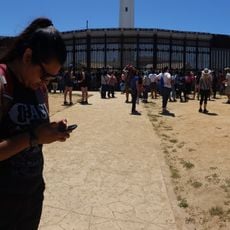
Modern border fencing stands several meters north of the monument, making it primarily accessible from the Mexican side in Playas de Tijuana. The best view is obtained by approaching the stone from the south.
The original 1851 marble shaft was so mutilated by visitors that its outlines were nearly destroyed and its inscriptions partly obliterated; the Barlow-Blanco Commission had it renovated in San Diego and rebuilt on site with a protective enclosure in 1894. The reconstructed shaft still stood at its original site as of 1974.
The community of curious travelers
AroundUs brings together thousands of curated places, local tips, and hidden gems, enriched daily by 94,043 contributors worldwide.