Hobby–Eberly Telescope, Research telescope at McDonald Observatory, Texas, US
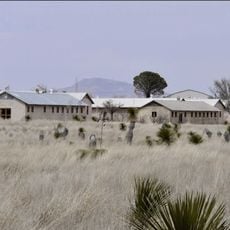
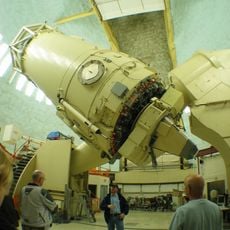
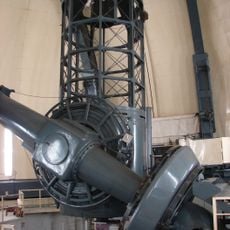
The Hobby–Eberly Telescope at McDonald Observatory in the Davis Mountains of West Texas has a 10-meter effective aperture and a primary mirror of 91 hexagonal segments measuring about 11 by 9.8 meters. The mirror is fixed at a 55° angle and rotates only around its base, while instruments at the focus move to track targets. A multi-year upgrade completed on July 29, 2015 raised the usable aperture from 9.2 to 10 meters and widened the field of view from 4 to 22 arcminutes.
First light came in 1996, and a multi-year upgrade finished on 29 July 2015 raised the usable optical aperture from 9.2 m to 10 m and widened the field of view from 4 to 22 arcminutes. The design was later used as the basis for the Southern African Large Telescope. The telescope is operated by the University of Texas McDonald Observatory for a consortium including UT Austin, Penn State, LMU Munich and Göttingen.
Scientists from the University of Texas, Pennsylvania State University, and German institutions collaborate on research projects using this advanced instrument.
Access to the telescope is strictly limited because it is a specialized research instrument used exclusively for scientific projects. The best way to learn more about this facility is to visit the McDonald Observatory site in West Texas and explore its visitor areas.
The primary mirror is not a single disc but 91 hexagonal segments, each held and aligned by actuators to within a fraction of a wavelength of visible light. The tower beside the telescope, the Center of Curvature Alignment Sensor Tower, calibrates those segments. The same design was later used as the basis for the Southern African Large Telescope.
The community of curious travelers
AroundUs brings together thousands of curated places, local tips, and hidden gems, enriched daily by 92,751 contributors worldwide.