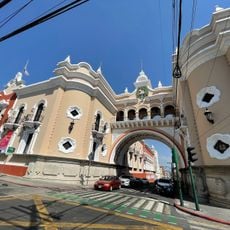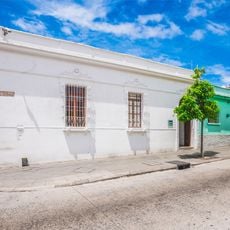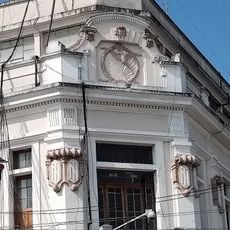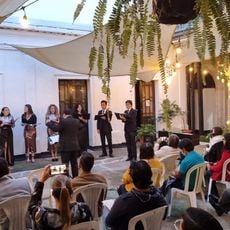
National Palace, Renaissance government building and cultural palace at Plaza Mayor, Guatemala City, Guatemala
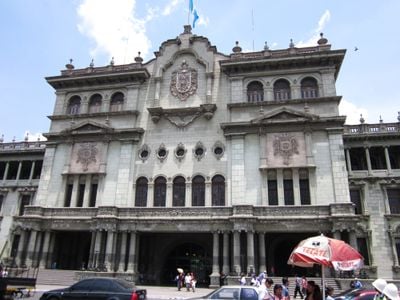
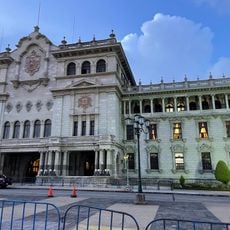
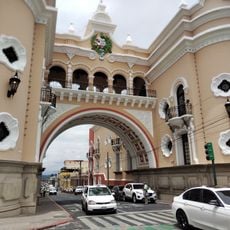
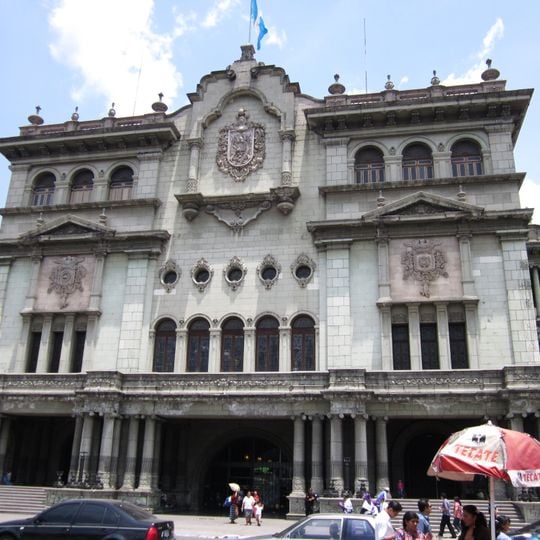
The National Palace is a symmetrical grey stone building with a central body and two lateral wings, each with three levels and a courtyard. Its eclectic design draws on the Monterrey Palace in Salamanca and the facade of San Ildefonso in Alcalá de Henares. Five round windows on the facade each carry a letter spelling Jorge Ubico, and murals by Alfredo Gálvez Suárez line the interior.
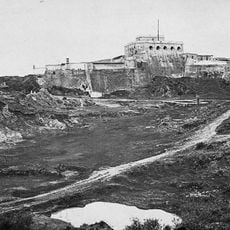
The site previously held the city jail and town hall, destroyed by the 1917–18 earthquakes. A 1927 design contest was won by Agustín Iriarte but never built; in 1932 Jorge Ubico published new bases, the first stone was laid on 4 July 1937, and construction ran from January 1939 to 10 November 1943, Ubico's birthday. He resigned on 1 July 1944, seven months after the opening.
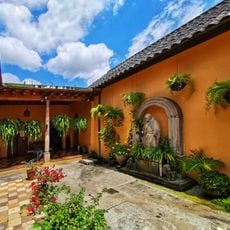
Locals call the palace "Palacio Verde" or "Guacamolón", after the green colour of the building and the avocado dish. In the second-level reception room hangs the Rosa Náutica, a two-tonne crystal lamp with four gold-plated quetzal figures, above a star-shaped drawing marking Kilometre Zero. The courtyards carry reliefs of the coat of arms of Santiago de Guatemala to the north and of the Republic to the south.
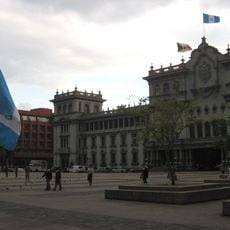
The palace faces the Plaza de la Constitución, formerly the Plaza de Armas, in Guatemala City's historic center, and is reached on foot from the surrounding streets. The building covers 8,890 m² with 350 rooms, so allow time to cross the courtyards and corridors. It is a working seat of the Executive and hosts protocol events, so some halls may be closed to visitors.
The building marks Kilometer Zero, the point from which all road distances throughout the country are measured. This symbolic location makes the palace the geographic reference center of the nation.
The community of curious travelers
AroundUs brings together thousands of curated places, local tips, and hidden gems, enriched daily by 92,748 contributors worldwide.