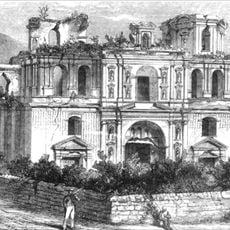
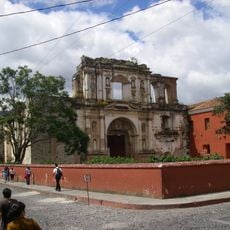
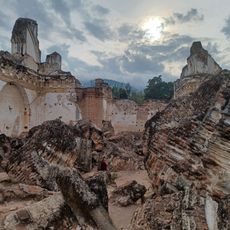
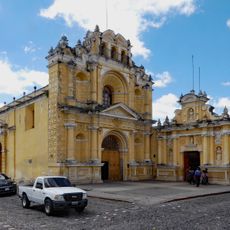
Church and Convent of Capuchins, Spanish baroque convent in Antigua Guatemala, Guatemala
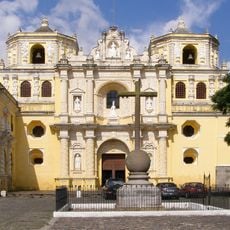
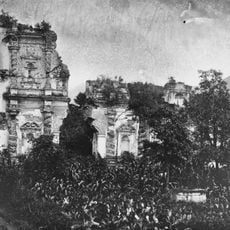
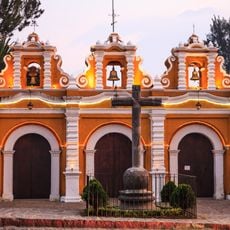
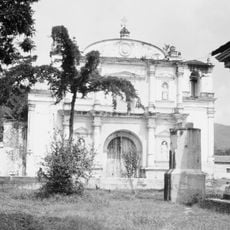
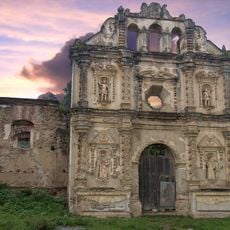
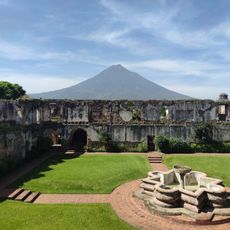
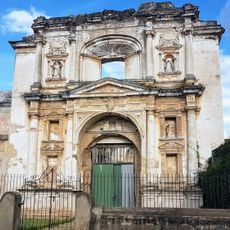
The Church and Convent of Capuchins has a white stone facade stained grey and green, with a large central arch flanked by plain columns. Purple flowers cover much of the left wall, and a small tree with red flowers stands on the right. A tiered stone fountain with a circular basin sits in the paved foreground.
King Felipe V approved the convent in 1725, the year the Capuchin order reached Santiago de los Caballeros. Construction began in 1731 under Diego de Porres and the church was consecrated in 1736, making it the last convent founded in the city and the first to waive the dowry required of new nuns. The 1773 Santa Marta earthquakes led to its abandonment and the transfer of its assets; the property was authorized for sale in 1813 and later used to dry coffee and house a dye works.
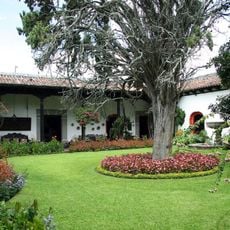
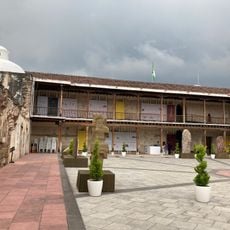
The name refers to the Capuchin order, a Catholic community that made this place their home. Visitors can see the different rooms where nuns lived and prayed, showing how religious life was organized in those times.
The complex is open to the public and houses exhibitions featuring colonial art. Visiting hours may be limited since the building still serves government functions, so plan accordingly.
The circular Torre del Retiro, the only one of its kind in the Americas, holds cells that each had their own latrine and study area, which is why the convent is sometimes called the continent's first apartment building. Beneath the novitiate, a vault rests on a mushroom-shaped column three metres in diameter.
The community of curious travelers
AroundUs brings together thousands of curated places, local tips, and hidden gems, enriched daily by 94,389 contributors worldwide.