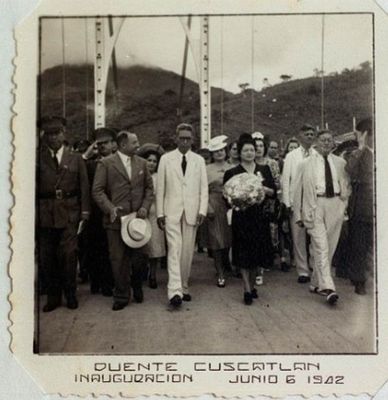
Cuscatlán Bridge, Suspension bridge over Lempa River, El Salvador.
The Cuscatlán Bridge is a suspension structure that spans the Lempa River, joining San Vicente and Usulután departments in El Salvador. It carries traffic along the Pan-American Highway and serves as a major route connecting different parts of the country.
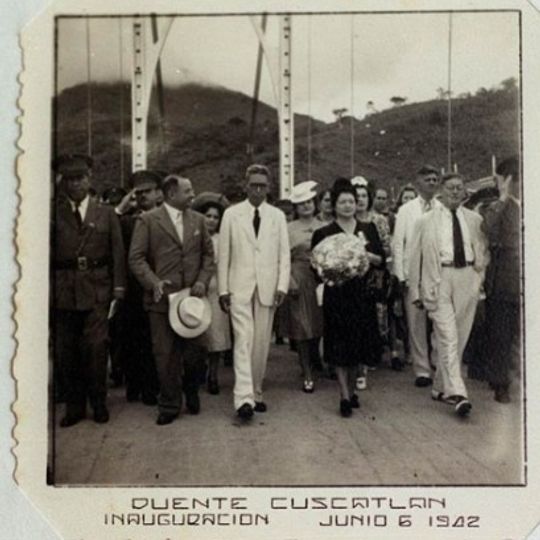
Construction began in June 1940, and President Maximiliano Hernández Martínez inaugurated the bridge on 6 June 1942, at a cost of 3.1 million colones; it was then the largest bridge in Central America and carried the Pan-American Highway. At 2:30 a.m. on 1 January 1984, FMLN militants bombed it, killing two army lieutenants and several soldiers and cutting off eastern El Salvador. A ford was built 150 m downstream, and the government rebuilt the bridge with Japanese assistance in 1998 for US$9 million.
The name Cuscatlán comes from the Nahuatl term for the region, not from a water-related phrase. The bridge carried a 1 colón toll for cars and 2.5 colones for trucks when it opened, and its 1942 inauguration by President Maximiliano Hernández Martínez drew attention as the largest bridge in Central America. After the 1984 bombing, a temporary ford was built 500 feet downstream to restore crossings.
The bridge stands at the Lempa River crossing between San Vicente and Usulután departments, on the Pan-American Highway route. After the 1984 bombing, the Ministry of Public Works built a temporary ford about 150 m (500 ft) downstream; the current crossing dates from the 1998 reconstruction.
The bridge's pillars were built from volcanic ash and stones, a detail visible at the base of the supports. Its 64 suspension cables each measured 16 inches (41 cm) in diameter, and the main span over the Lempa reached 820 feet (250 m).
The community of curious travelers
AroundUs brings together thousands of curated places, local tips, and hidden gems, enriched daily by 92,894 contributors worldwide.