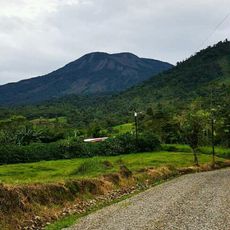
Poás Volcano, Active stratovolcano in Central Valley, Costa Rica.
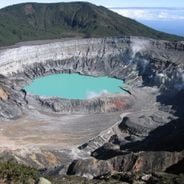
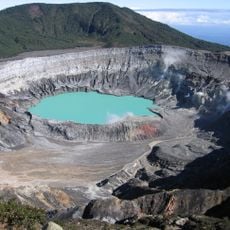
Poás Volcano is a stratovolcano in the Central Valley of Costa Rica, with a main crater roughly 1.6 km wide. The sulfuric acid lake inside releases hot vapor while several fumaroles remain active along the inner walls.
Poás has erupted at least 39 times since 1828. Its largest recorded eruption, on 25 January 1910, sent a steam and ash column 8,000 metres above the crater and produced 640,000 tonnes of ash. A strong phreatic explosion occurred on 24 March 2006, and in April 2017 eruptions led to the park's closure until September 2018.
According to the national park administration, the name Poás comes from a local shrub resembling hawthorn with forked thorns; historian Percy Rodriguez notes another theory of a tribe called Poas. A 1663 document calls the area "pastures of Puas", west of the Puas River. Before the park existed, people collected the crater's acid water in glass bottles and sold it in pharmacies for muscle pain, cavities and warts.
Visitors should book reservations ahead and can reach the volcano between 7 AM and 2 PM. Access to the crater follows paved paths, with time near the rim limited to short intervals to reduce gas exposure.
The northern crater lake, Laguna Caliente, sits at about 2,300 m in a crater roughly 0.3 km wide and 30 m deep, with liquid sulfur coating its bottom. Its toxic sulfur-iron chemistry limits life to Acidiphilium bacteria, and eruptions often throw crater-lake water out in geyser-like jets. Before the national park existed, people climbed up to bottle the acidic water and sold it in pharmacies for muscle pain, warts and toothache.
The community of curious travelers
AroundUs brings together thousands of curated places, local tips, and hidden gems, enriched daily by 94,110 contributors worldwide.