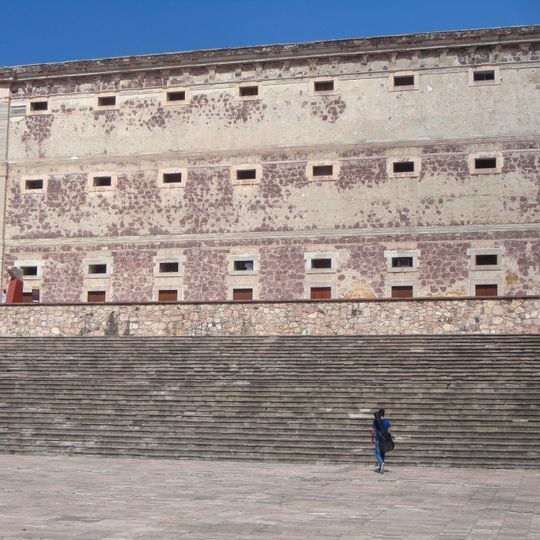
Alhóndiga de Granaditas, Neoclassical warehouse and museum in Guanajuato City, Mexico.
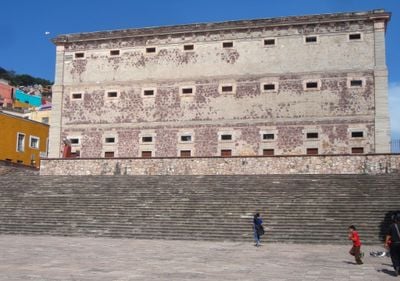
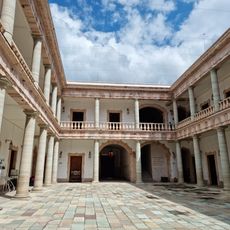
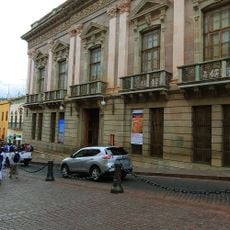
Alhóndiga de Granaditas is a massive stone building from the colonial period with a central courtyard in Guanajuato City. Tuscan columns support the upper floors, while two symmetric staircases connect the levels.
Construction began in 1796 by order of Viceroy Miguel de la Grúa Talamanca de Carini y Branciforte, designed by José del Mazo y Avilés and completed on 7 November 1809. Intended to store grain, it became a royalist stronghold in September 1810, when Juan Antonio Riaño and about 300 loyalists held it against 20,000 insurgents. Riaño died in the assault, and the building was taken and sacked on 28 September 1810.
The name comes from the Arabic term for grain warehouse and recalls Moorish trading traditions in Spanish colonial architecture. Visitors today see frescoes by painter José Chávez Morado inside the courtyard, depicting scenes from the independence movement.
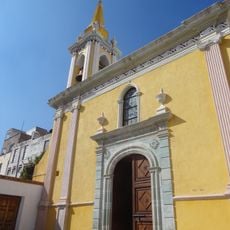
The building stands at the corner of Calle 28 de Septiembre and Mendizábal in the historic centre, facing the city's Historical Archive, with the Church of Belem behind it. Its two entrances are a small east door and a larger north door, from which stone steps descend to a small plaza at the foot of the hill. The wide steps beside the building become an open-air auditorium during the International Cervantino Festival.
Iron cages once hung on the four corners of the building displaying the heads of four independence leaders. They remained there for ten years to discourage further uprisings.
The community of curious travelers
AroundUs brings together thousands of curated places, local tips, and hidden gems, enriched daily by 92,938 contributors worldwide.