Puente de Piedra de Acámbaro, Colonial stone bridge in Acámbaro, Mexico.
The Puente de Piedra de Acámbaro is a nine-arch stone bridge over the Lerma River, built with stone set in lime mortar and faced with light yellow cantera. It measures 160 m long and 5.30 m wide, with a largest arch spanning 12.5 m and rising 21 m. The piers have pointed and trapezoidal cutwaters, and 48 stone rest bays line the crossing.
A first stone bridge was ordered by the cathedral chapter of Michoacán through an act of 11 April 1750; it was probably swept away by the Lerma, and a surviving arch could still be photographed downstream in the early 20th century. The present bridge was promoted by Fray Antonio de San Miguel after the frosts of 27 and 28 August 1785 caused a famine, to give work and food; it was paid for by the city's merchants and finished before 1800.
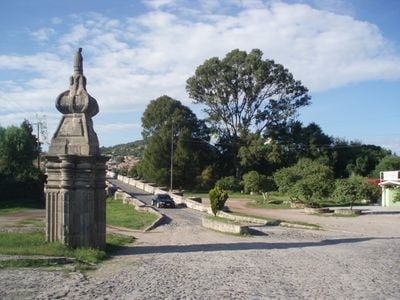
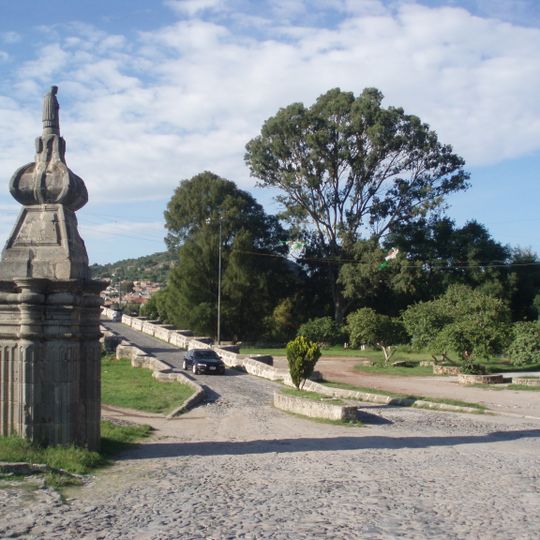
Locals long called it the "Puente del Hambre" (Bridge of Hunger) because Fray Antonio de San Miguel promoted its construction to give work and food to Acámbaro's inhabitants during the famine caused by the frosts of 27 and 28 August 1785. The four grey cantera sculptures at the bridge ends, Mary with the Child and Saint Joseph on the north side, Saint Francis and the Virgin of Guadalupe on the south, are in a Neoclassical style.
The bridge is accessible to both pedestrians and vehicles and connects several neighborhoods together. Stone benches are placed along the way for resting and provide a good vantage point to view the river.
The four corner pedestals carry grey cantera sculptures: the Virgin Mary with the Child and Saint Joseph on the north side, Saint Francis and the Virgin of Guadalupe on the south, in a Neoclassical style. They crown the pedestals where the widened bridge entrances end.
The community of curious travelers
AroundUs brings together thousands of curated places, local tips, and hidden gems, enriched daily by 94,137 contributors worldwide.