Templo y convento de San Joaquín de Tacuba, Colonial religious complex in Tlacopan, Mexico
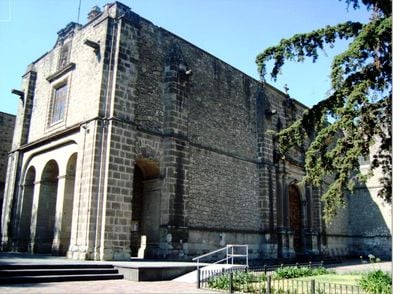
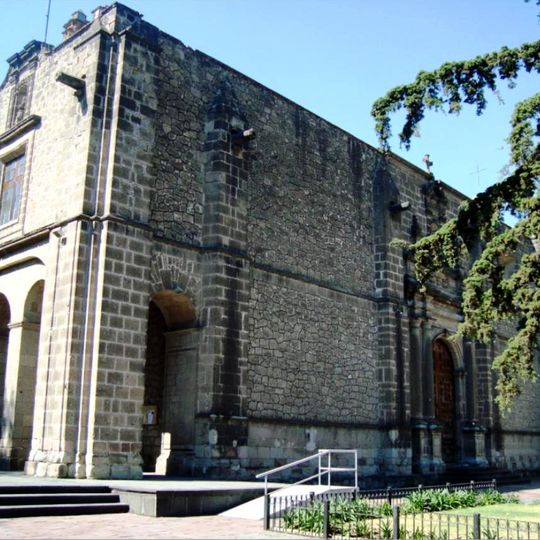
Templo y convento de San Joaquín de Tacuba is a Carmelite church and monastery begun in the late 17th century and finished in the mid-18th. The church runs east to west in gray quarry stone, with a Latin cross plan and a circular dome over the crossing. Its sober facade has a three-bay narthex, the choir window above and a niche holding a sculpture of Saint Anne; a espadaña, a plain wall bell gable, stands at the southeast corner.
The Discalced Carmelites established this religious complex in 1689 based on a royal decree. This was the eleventh foundation of the order in Mexico and marked an important expansion of their presence in the region.
The austere facade carries a niche with a sculpture of Saint Anne of Nazareth above the choir window, while a sculpture of the church's patron stands on the richer side portal. Following Carmelite austerity, the temple has a espadaña, a plain wall-mounted bell gable, at its southeast corner rather than a tower.
The complex is located in the Miguel Hidalgo district and continues to function as an active place of worship where you can attend services and explore the historical architecture. Visiting outside of prayer times gives you better access to see the interior spaces without interruption.
The complex contains a historic water cistern with a barrel-vaulted portico, a structure found nowhere else in Latin America. This cistern was essential for supplying water to the monastery and shows the practical engineering solutions of the early colonial period.
The community of curious travelers
AroundUs brings together thousands of curated places, local tips, and hidden gems, enriched daily by 94,058 contributors worldwide.