Nuestra Señora de Loreto Church, Neoclassical church in Centro Histórico, Mexico City, Mexico
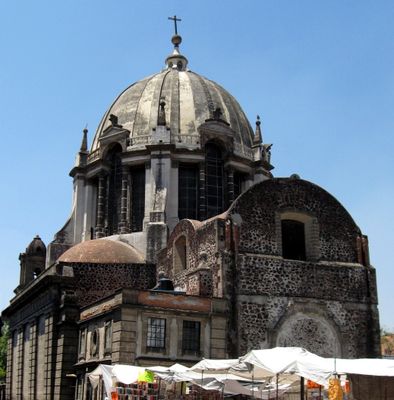
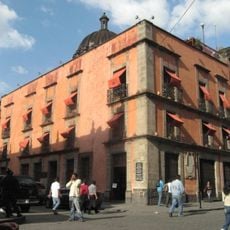
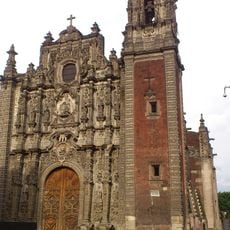
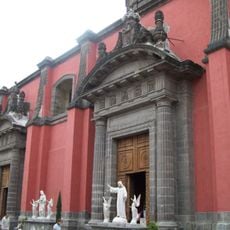
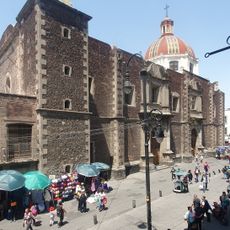
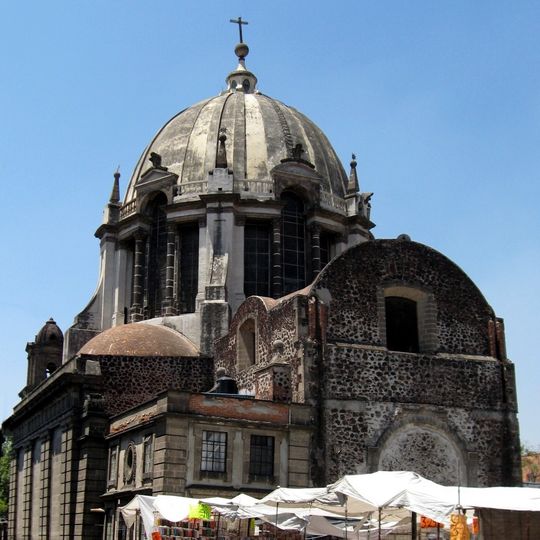
Nuestra Señora de Loreto Church is a neoclassical building whose basic layout remains Baroque, with a dome 30 meters wide and 15 meters high, the largest built in Mexico City during the colonial period. Its lower section is of rough, dark volcanic stone with patches of smooth grey stone, and the nave measures 2,800 square meters and 30 meters high. The interior has no main altarpiece in the rotunda, and the ceilings of the cupola and nave are almost bare of decoration.
The church was constructed between 1806 and 1819, representing one of the final major religious building projects of Mexico City's colonial era. Architects Ignacio Castera and Agustin Paz oversaw its creation during a transitional period in the city's architectural history.
The church is dedicated to Our Lady of Loreto, whose image was kept in the Jesuit college of San Gregorio and later in the Convent of La Encarnación before being brought here. On 15 July 1909 the Congregation of the Sacred Hearts of Jesus and Mary took possession of the temple, and Father Wilfrido celebrated the first mass at 6 a.m. The image was moved to San Pedro y San Pablo when the church closed in 1832 and returned in 1850.
The building sits on Plaza de Loreto in the city center and is accessible by various public transportation options. The plaza provides good access to the site, and visitors should plan to explore the historic area on foot.
The tilt comes from a construction error: one side was built with solid, heavy stone, the other with tezontle, a light porous volcanic rock. By 1832 the church had sunk so badly that authorities closed it and moved the image of Our Lady of Loreto to San Pedro y San Pablo; it reopened in 1850. A large crack in the nave was repaired in 1995, but nothing has corrected the lean.
The community of curious travelers
AroundUs brings together thousands of curated places, local tips, and hidden gems, enriched daily by 94,666 contributors worldwide.